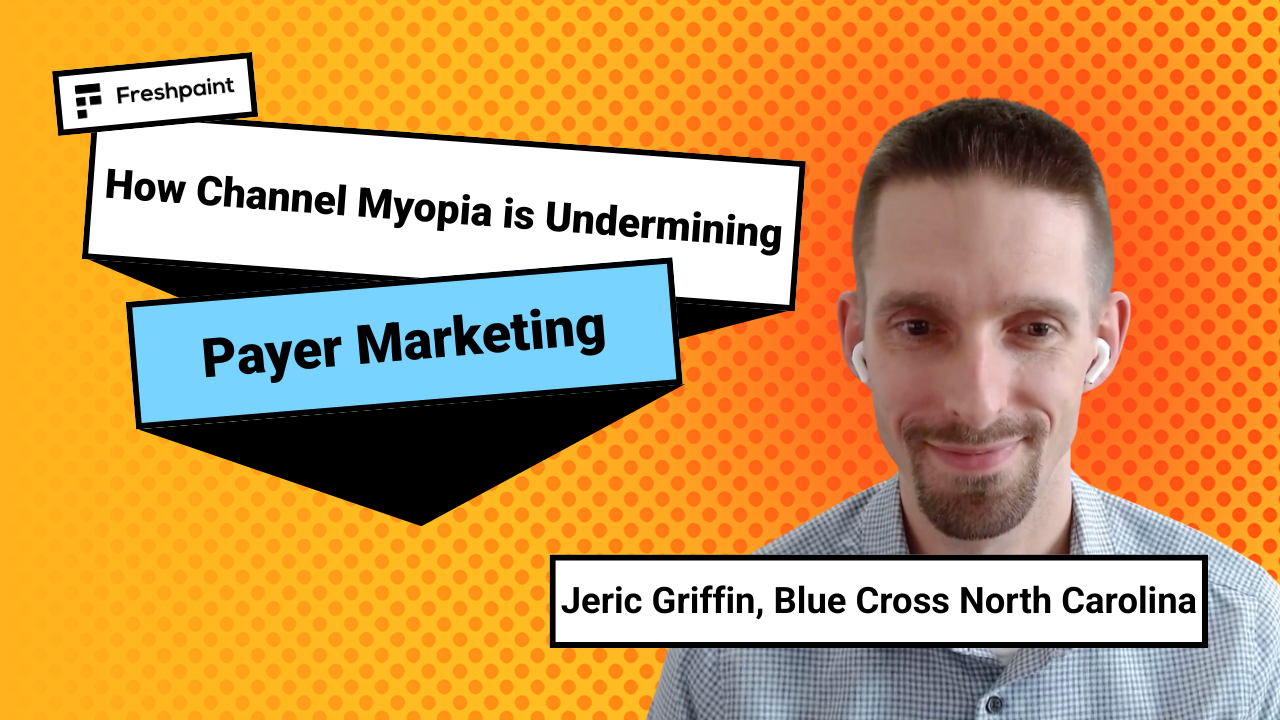
How Channel Myopia Is Undermining Payer Marketing with Jeric Griffin

Ask healthcare marketers how they allocate their budgets and they’re likely to go into detail about their data-driven approach—how they shift spend toward channels with the best ROI or double down on the tactics with the lowest cost per conversion. Some will proudly brag that they cut budgets when success is not immediately apparent.
But what if the data driving those decisions is often wrong?
Not because the clicks didn't happen or the conversions aren't real. But because the attribution model is fundamentally flawed—last-click attribution gives 100% credit to whichever channel touched the customer last, ignoring everything that happened before.
The result? Marketing teams optimize for what’s easy to measure rather than what actually drives sustainable growth.
Jeric Griffin has spent his career in performance marketing across multiple industries. Now he leads paid media strategy at Blue Cross of North Carolina, where they’ve built a framework for moving beyond last-click dependency.
His conversation with Freshpaint CEO and Marketing Rounds host Ray Mina is a brutally honest take on what the data actually shows versus what marketers want it to show.
1. The Flaws of (Most) “Data-Driven” Marketing
Most healthcare marketers claim to be data-driven. They have dashboards. They track metrics. They report numbers to leadership.
But when you dig into what data they're actually using, the picture changes fast.
"I'd say roughly 80% of the people I talk to, if I look at their data, the data that's driving their decisions shouldn't be," Jeric said. "It's not data that's helping them make the best decisions for optimization, efficiency, and ultimately ROI."
Most teams are looking at surface-level metrics: Ad platform data. Last-click attribution. PDFs from agencies showing cost per click and conversion counts.
Those metrics tell you what happened at the last touchpoint before conversion. They don't tell you where the journey actually started, what influenced the decision, or how multiple channels worked together to drive the outcome.
And that’s only half the story.
"Everybody knows that most ad platforms, if not all of them, are gonna take more credit than they should for each conversion," Jeric explained. "You end up double or even triple counting some conversions depending on how many different channels or platforms you're using."
This creates a cascading series of bad decisions:
- You over-invest in last-touch channels (paid search) because they get all the credit
- You under-invest in upper and mid-funnel channels because they look inefficient
- You pull budget from channels that actually start customer journeys
- Your overall efficiency decreases even though individual channel metrics look good
What this means for you
Simply put—stop accepting ad platform data as the only source of truth and:
Audit your data quality:
- What attribution model are you actually using?
- Are you looking at data from individual ad platforms or unifying sources to get the full picture?
- Can you see how channels work together and influence one another?
- Are you potentially double- or triple-counting conversions across platforms?
Challenge your “data-driven” claims:
- How deep does your data analysis actually go?
- Are you looking at customer journeys or just platform reports?
- Can you attribute marketing performance to downstream value (e.g., appointments attended, revenue generated)?
If you can’t answer these questions confidently, you’re likely making decisions based on data that’s pointing you in the wrong direction.
2. Don’t Give Paid Search More Credit Than It Deserves
Here’s the pattern Jeric called out on the podcast: Marketing teams look at their last-click attribution data and, unsurprisingly, paid search is the winner by a wide margin. So they put more budget into the channel. And, because their budget didn’t grow, it means they reallocated it from other channels.
"You'll get in a conversation with someone and they'll say, well, we need to just put, instead of putting 70% of our budget into paid search, which we already are, we need to just put all of it in there and completely take out everything else," Jeric said.
The problem with this logic is that paid search captures demand, it doesn’t create it.
Someone doesn't wake up and immediately search for health insurance. They become aware of their need through other channels. They see ads. They research options. They talk to friends. They consider competitors. Then—when they're ready to make a decision—they search.
"When it's over and they go back and look and say, well, we made those changes based off of the data that was driving our decisions, why are our sales down?" Jeric explained. "They'll never be able to figure out why their sales were down if they don't look at the data through a different lens."
Without multi-touch attribution, you can't see the full journey. You just see that paid search was the last click. So you give it all the credit. And you starve the channels that actually started the journey.
And as you scale paid search spend, costs go up while returns diminish.
What this means for you
Intent is finite. You can capture everyone actively searching for your service right now. But that pool isn't infinite. And as you scale paid search spend, costs go up while returns diminish.
Need evidence you’re rapidly approaching the ceiling in intent channels? Look for these signs:
Cost efficiency declining
- Cost per lead/sale increasing despite stable or growing volume
- Click-through rates declining as you expand targeting
- Need to bid higher to maintain same position/visibility
Volume plateauing
- Can't scale spend without degrading efficiency
- Running out of high-intent search queries to target
- Audience sizes maxed out in paid social
Contextual metrics degrading
- Click-through rates dropping
- Quality scores declining
- Conversion rates decreasing even as traffic increases
If you see these warning signs in your performance data, don’t abandon intent channels like paid search—they’re still critical for capturing demand. Just recognize their limitations and start building a true multi-channel strategy that create awareness and consideration before the search moment.
3. Multi-Channel ≠ Isolated Channel Experiments
Here's the mistake most marketers make when they try to move beyond paid search: They treat new channels as isolated experiments.
They run CTV ads. Nothing converts directly. They declare it doesn't work.
They try display advertising. Same result. They pull the budget.
The problem isn't the channels. It's that they're running them in a vacuum without orchestration.
Jeric described the typical scenario: "You have a user who clicks on a Facebook ad and then life happens—the phone rings, a kid spills something, somebody knocks on the door. They don't end up converting through that ad."
That seems like a failed conversion. But watch what happens next:
"That same person later sees but doesn't necessarily click on a CTV ad or a display ad from an entirely different channel. Seeing that triggers them: oh yeah, I was gonna buy that thing I saw that Facebook ad for."
Where do they go? They don't go back to Facebook to find that ad. They go to Google and search.
If you're only looking at last-click attribution, Google gets 100% of the credit. Facebook gets zero. CTV gets zero. Display gets zero.
But without Facebook starting the journey, without CTV reinforcing it, without display creating that reminder moment—the search never happens.
"Depending on first click versus last click, if we wanna look at linear and give it all the same credit, or if we want to look at a reverse J and give the Facebook ad credit—that obviously changes your spend allocation," Jeric explained.
This is why channels need to work together, not compete for credit:
- Upper funnel creates awareness (CTV, display, social)
- Mid-funnel builds consideration and retargets engaged audiences
- Lower funnel captures intent when people are ready (search)
Each plays a role. Expecting CTV to drive direct conversions is like trying to paint with a pencil—you're using the wrong tool for the job.
What this means for you
Stop running isolated channel tests and use different channels to play a strategic role at each stage of the funnel.
4. The Virtues of Conversion Optimization
Here's the ratio Jeric sees across most organizations: 90% of effort goes into acquisition. 10% (or often zero) goes into conversion rate optimization.
Teams spend huge budgets driving traffic. They invest in agencies, ad platforms, sophisticated targeting. They obsess over cost per click and impression share.
Then users get to the conversion point—the form, the enrollment flow, the appointment scheduler—and the experience is terrible.
"A lot of times you'll see these huge marketing budgets, huge marketing advertising teams or investments in agencies, and a lot of times the strategy is really sound," Jeric said. "Except for the actual experience once they get to the point of conversion."
He described it perfectly: "Leading the horse to the water, but then not allowing the horse to drink when they get there."
The neglect happens for a few reasons:
- CRO is hard: It requires different skills than media buying. It touches product, operations, IT. It's easier to just buy more traffic than fix the conversion experience.
- Agencies want to sell more ads: Some but not all marketing agencies are incentivized to increase ad spend, not optimize what happens after the click.
- Teams lack expertise: Conversion optimization is a specialized discipline that many marketing teams don't have in-house.
The result? Massive waste. You're spending to acquire traffic you can't convert.
Jeric recounted a recent example someone shared that exemplifies this scenario: "Their advertising strategy was great and they were getting people to the conversion point, but the conversion point was still optimized for desktop—the old Blackberry from 2005 where you had to scroll around a desktop view on your phone."
His advice to them: "Turn your ads off right now until you get this part fixed."
Even if your conversion point isn’t stuck in the early 00s, there's good reason to evaluate it: Small improvements in conversion rate can often double your results.
Not 5% improvement. Not 10%. Jeric estimates many healthcare organizations could double conversion rates with table-stakes optimization:
- Mobile-responsive design
- Simplified forms
- Clear calls-to-action
- A/B testing button colors, placement, copy
- Different experiences for different audiences (ortho vs cardio, young vs elderly)
What this means for you
Stop treating conversion optimization as an afterthought and, instead, make it core to your marketing strategy.
Quick wins (start here):
- Ensure mobile-responsive design (seems obvious, but check yours)
- A/B test button colors, sizes, placement
- Test dynamic landing pages for paid vs organic traffic
- Simplify forms—remove unnecessary fields
- Make CTAs prominent and clear
Audience-specific optimization:
- Don't use one-size-fits-all experiences
- Younger audiences may prefer different UI than elderly
- Different service lines may need different conversion flows
- Test experiences tailored to demographic segments
Systematic CRO process:
- Carve out 5-10% of budget for testing
- Run controlled experiments with clear hypotheses
- Track efficiency in context (don't just chase one metric)
- Stair-step successful tests—don't scale to 100% overnight
The math is simple. If you can double your conversion rate, you've effectively doubled your marketing ROI without spending another dollar on acquisition.
Most organizations have enormous untapped opportunity here. They're just not looking at it because they're too focused on buying more traffic.
The Shift Healthcare Marketing Must Make Today
Future growth for payers isn't about running more channels. It's not about spending more on paid search or adding CTV to the mix. It's about building an operating model for audiences, orchestration, and attribution that's credible enough to survive financial scrutiny.
That doesn't require massive budgets or data science teams (though those help). It requires being honest about what your current data actually shows, asking better questions about attribution, and being willing to test beyond the comfort zone of intent channels.
"Start with five to 10% for something like that," Jeric advises. "It doesn't have to be something earth-shattering. It could be something as simple as landing page optimization. You'll know in a few days what's working well for you."
The alternative is continuing to optimize for last-click efficiency while wondering why growth is plateauing, costs are increasing, and competitors are winning.
Experience the full conversation where Jeric discusses why most ad platforms intentionally hide attribution settings, how to avoid the trap of optimizing cost per click while killing overall ROI, why CRO might double your conversions with simple tests, and the "stair-step" methodology for scaling pilots without catastrophic failures.


.png)