How To Make Facebook Ads HIPAA-Compliant and Still Get Conversion Tracking




A quick note before you read: On June 20, 2024, a federal judge vacated a narrow part of the Office for Civil Rights (OCR) web tracker guidance that an individual’s IP address combined with a visit to a public healthcare website triggered a HIPAA violation. However, the rest of OCR’s web tracking tech guidance remains intact.
For healthcare marketers, Facebook Ads create a difficult tradeoff between performance and compliance.
That's because Meta isn’t HIPAA-compliant. Meta doesn't sign Business Associate Agreements (BAAs), and the Meta Pixel sends PHI to Meta servers. As a result, we continue to see class action lawsuits against healthcare providers for using Facebook tracking, as well as healthcare organizations themselves hit with growing fines. If you followed the Facebook documentation to set up your ads and conversion tracking using the Meta Pixel, remove the Pixel now.
While the Meta Pixel is not HIPAA-compliant, its removal from your digital strategy does not have to derail your marketing campaigns or put your growth program at risk. Hundreds of healthcare marketing teams run privacy-safe campaigns through Meta to successfully and compliantly drive patient acquisition, downstream revenue, and member enrollment for payers. They do so with stronger controls around the data they share with Facebook so they can maintain attribution, conversion tracking, and campaign optimization without exposing protected health information (PHI).
In this article, we'll explain why standard Facebook tracking creates a HIPAA risk, where PHI commonly leaks into ad workflows, and how healthcare organizations can continue using Facebook Ads by limiting data-sharing to only the points necessary for attribution and performance measurement.
Key Takeaways
- HIPAA compliance and Facebook advertising don’t have to be mutually exclusive. The challenge isn’t whether to use Meta Pixel — it’s ensuring the data shared with Meta never includes protected health information.
- PHI may unintentionally enter Facebook tracking in more places than most teams realize. URLs, page content, event names, and conversion data can all unintentionally expose sensitive information if they aren’t properly governed.
- The strongest measurement strategies focus on governing data, not eliminating it. With the right controls in place, healthcare organizations can preserve attribution, optimize campaigns, and reduce compliance risk at the same time.
Are Facebook Ads HIPAA-Compliant?
Facebook Ads aren’t HIPAA-compliant with the standard Meta Pixel setup. Meta doesn’t sign a BAA, and the Pixel can capture identifiers plus page and action data that may reveal health information, which can put healthcare organizations in a difficult HIPAA compliance position.
.png)
In this article we explain the path forward: you can still leverage Facebook Ads, but you need much tighter control over what gets sent to Meta. Meaning you need to remove the Pixel and utilize a governance layer that limits data sharing to only what is needed for attribution and conversion tracking, while keeping health-related information out of Facebook entirely.
Why Meta Creates a Mega Problem
One of Facebook's strongest value propositions is its ability to create campaigns that maximize conversions for advertisers, by optimizing for clicks that are more likely to convert. Let's play this out in a healthcare context: To maximize conversions, you send a successful action (say, a new member sign-up) back to Facebook. Based on those new member sign-ups, Facebook will use its treasure trove of data to find more users who have similar characteristics and serve them the ad.
But some fundamental things make this impractical for healthcare marketers concerned with HIPAA compliance:
- Personal identifiers are baked into Facebook’s conversion formula. To maximize conversions, Facebook needs to know the identities of the users who clicked on the ad and converted. Facebook then uses all the data points it has about the people behind the initial successful conversions to build a larger audience of users with similar traits. A key data point that goes into this formula is the user's personal identifier, required by Facebook to make this feedback loop work. That, when combined with the next set of data, puts healthcare marketers at risk.
- Health information is one of the categories of data that Facebook captures. When a Facebook user clicks an ad and lands on a healthcare organization’s website, the Meta Pixel loads and captures as much data as possible. This can include URLs, names of pages visited, and actions taken – all of which could be health information. If the Meta Pixel can see that a visitor navigated to a page on diabetes treatment, for example, that’s considered health information.
These problems come down to the fact that you can't control the information sent to Facebook using the Pixel. By default, the Pixel is designed to capture as much user activity and context as possible, leaving healthcare organizations with limited control over what is ultimately shared (we wrote more about how tracking technology actually works here).
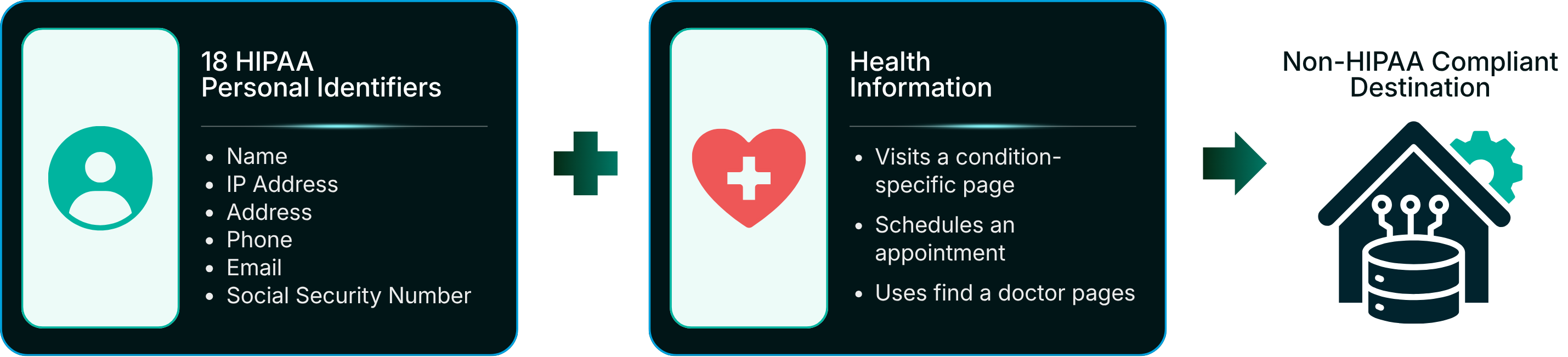
And if you're a healthcare provider, the two types of data that make up PHI you're concerned about Facebook having access to are:
- Personal Identifiers. This is any data that can reveal the actual identity of an individual. Facebook doesn't consider things like an IP address as PII, but the HIPAA Safe Harbor rule does, along with 17 other identifiers. The Meta Pixel captures IP addresses, device IDs, and even identifiers entered on form and submission pages.
- Health Information. This is the medical information about the user. Something as simple as visiting a find-a-doctor page or viewing a treatment page with a URL containing “fibrolamellar carcinoma” would be considered health information. The Meta Pixel captures the page names and actions across the site.
Where Does PHI Leak in Facebook Tracking?
The data that Facebook tracking can pick up after someone clicks and lands on a healthcare website turns into PHI when an identifier is paired with information that suggests a person’s condition, treatment interest, provider search, or other health-related activity.
Let’s review the most common leak points healthcare marketing teams can miss:
- URLs and page titles can reveal sensitive intent if they include terms like condition, specialty, or appointment type.
- Query parameters may expose details passed in the URL, including campaign, form, and user-specific information.
- Event names and event properties create risk when they explicitly describe a health-related conversion. Event properties add additional risky context by attaching details about the person who viewed, selected, searched for, or hit submit.
These common leak points are fields that require healthcare teams’ close scrutiny. To avoid compliance issues, review should occur when setting up the Facebook Ad before any data is shared with Meta.
Why does this become a HIPAA issue?
Any ad clicks originating from Facebook means Meta has the user's identity. And since the Pixel is capturing pages that the user visits that may contain health information, sharing that data back to Facebook is a HIPAA violation. The most important thing to understand here is that PHI = Personal Identifiers AND Health Information. The violation happens when you share that combined dataset with a non-compliant destination like Facebook.
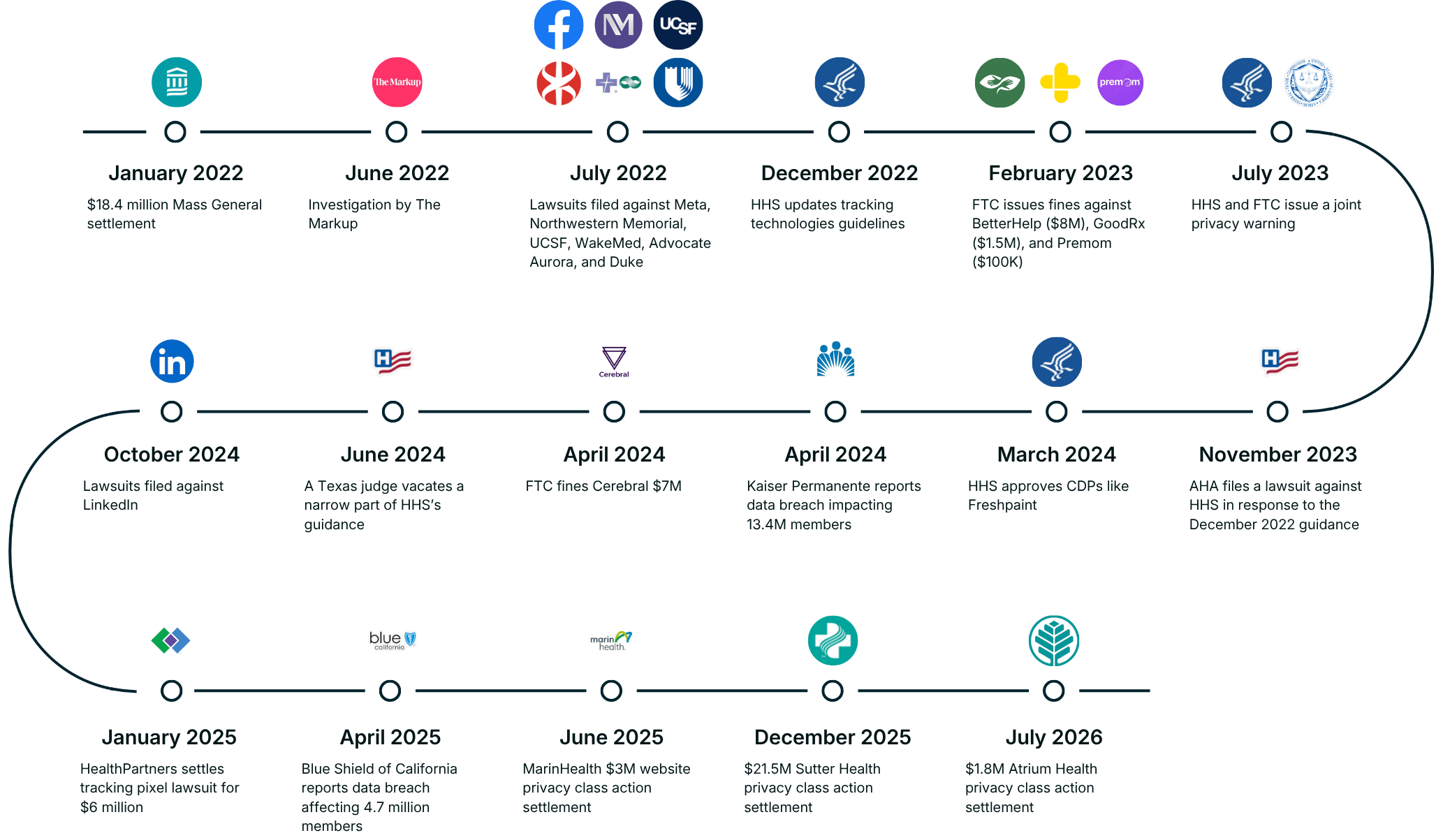
If you’re thinking, “I don't even use health information in Facebook campaigns," you’re not off the hook. What matters is that the Facebook Pixel you loaded collects that data, and Meta is certainly using it. It’s also past time for a wait-and-see approach to be advisable. An investigation by The Markup found that PHI was being sent to Facebook servers by multiple major healthcare providers. That set off a series of events that has led to class action lawsuits, updates in the HIPAA guidelines, Federal Trade Commission (FTC) fines as high as $7.8M, and ultimately an ultimatum issued by the FTC and the U.S. Department of Health and Human Services (HHS).
There is a way forward, though. You can continue to use Facebook ads in a healthcare setting while maximizing conversions as a bidding strategy. To do so, you need to:
- Discontinue Facebook's approach to data by removing the Pixel
- Block all health information from being shared with Facebook
Let's see how you do that.
Real-World Examples: Low-Risk vs. High-Risk Facebook Campaigns in Healthcare
Here is a simple way to think about the risk spectrum. The more that a campaign’s targeting strategy, landing pages, and conversion tracking reveal a person’s health condition or treatment intent, the riskier it becomes.
Let’s review three sample scenarios: low, medium, and high risk.
- Low risk: A family medicine clinic promotes broad awareness ads for primary care or annual checkups and sends traffic to generic service pages. The campaign isn’t risk-free, but it is less likely to expose sensitive health intent than campaigns tied to condition-specific pages or conversions.
- Medium risk: A dermatology clinic runs ads with carefully crafted creative that is general and avoids explicitly signaling a diagnosis or treatment category. Risk increases, though, if the click leads to pages, URLs, or conversion events that reveal interest in a specific skin condition or procedure.
- High risk: An oncology clinic runs campaigns tied to cancer diagnosis, treatment, or appointment intent. At that point, the landing page, conversion event, and surrounding tracking data can strongly imply highly sensitive health information, making standard Facebook tracking especially risky.
How to Make Facebook Ads HIPAA-Compliant
The challenge with the Meta Pixel is that it creates a direct path between your website and Facebook. Once the Pixel loads, Facebook can collect website activity, identifiers, and other contextual data before healthcare organizations have an opportunity to evaluate whether that information should be shared. A HIPAA-conscious approach introduces a governance layer between your website and Facebook. Rather than sending data directly to advertising platforms, data first passes through a controlled environment where it can be reviewed, filtered, and governed before any information is shared downstream. This is the role a privacy-first healthcare marketing platform like Freshpaint plays. Instead of a direct Website → Facebook connection, organizations gain a governed data flow: Website → Freshpaint → Facebook.
That additional layer creates several important safeguards:
- Business Associate Agreement (BAA) coverage: Freshpaint signs a BAA and is purpose-built to handle healthcare data. This gives organizations a compliant environment for collecting and managing marketing and analytics data, before it reaches downstream tools that may not be able to support HIPAA requirements.
- Safe-by-Default data governance. Traditional marketing pixels are designed to collect and transmit as much information as possible. Freshpaint takes the opposite approach. Data is blocked from non-compliant destinations by default, requiring organizations to explicitly decide what information can be shared. This governance model is built around updated HHS/OCR guidance for HIPAA‐compliant tracking, giving teams a more defensible foundation as regulations evolve.
- Server-side controls before data leaves your environment. Rather than allowing third-party platforms to collect data directly from a user's browser, Freshpaint evaluates and filters data server-side before it reaches advertising and analytics tools. This gives healthcare organizations significantly greater control over what information is ultimately shared.
- Consent management: Freshpaint goes beyond banner‐based consent by enforcing user preference tools, data types, and purposes across downstream platforms, with audit trails for compliance review.
- Web tracker monitoring and audit-ready visibility: Freshpaint discovers every tracker on organizations’ websites, detects new or hidden pixels, blocks risky data flows and maintains audit logs showing what data was shared, blocked and when.
- Granular control over data sharing. Different platforms require different information. Freshpaint allows organizations to define the exact events and properties sent to each destination. This enables marketing teams to preserve attribution and performance measurement without unnecessary or sensitive information being transmitted.
- Governance that scales. HIPAA compliance cannot depend on individual marketers remembering dozens of configuration rules across campaigns, landing pages, and tracking tools. With central enforcement and governance controls, organizations greatly reduce the risk of human error and create a more consistent compliance posture across their marketing technology stack.
Ad Click Attribution
Facebook appends a click identifier (fbclid) when a user arrives from an ad. Capturing that identifier allows healthcare marketers to connect downstream conversions back to the original ad interaction without relying on the Meta Pixel. A privacy-first governance layer can capture the click identifier, store it in a HIPAA-compliant environment, and selectively pass it to Facebook when appropriate. This preserves attribution while giving organizations control over what additional information is — and is not — shared with Meta.
Conversion Tracking
Attribution only becomes valuable when it is tied to a business outcome. Once a user completes a desired action — such as becoming a new patient, requesting an appointment, or submitting a lead form — a governed tracking layer can record that conversion and connect it to the original ad click. Because the conversion event is linked to the click identifier, Facebook can understand which campaigns are driving results without receiving unnecessary health-related context. The key is controlling the exact event data that is shared and ensuring that event names, properties, and metadata do not expose PHI. Leveraging a privacy-first marketing platform allows healthcare organizations to maintain conversion measurement while applying safeguards that standard pixel-based tracking cannot provide.
Maximizing New Conversions
Facebook's conversion optimization models require feedback signals to understand which users are most likely to complete a desired action. Historically, the Meta Pixel collected far more information than was necessary to support that feedback loop. A governance-first approach changes that model. Instead of sending broad website activity and health-related context to Facebook, organizations can limit data sharing to only the information required for attribution and optimization.
In practice, this often means:
- A Facebook click identifier (fbclid) to connect conversions to ad interactions.
- A conversion event that represents the business outcome being measured.
- An approved identifier used for matching and optimization purposes.

The critical distinction is that Facebook needs signals that help attribute and optimize campaigns. It does not need health-related information about the individual who converted.
What a HIPAA-Compliant Facebook Ads Workflow Looks Like
This approach allows healthcare organizations to preserve campaign measurement and performance without relying on the standard Meta Pixel model.
- Remove tracking technologies that automatically transmit website activity and health-related context to Facebook.
- Route advertising and analytics data through a privacy-safe governance layer that can evaluate what information is being shared with downstream platforms.
- Limit the data your organization sends to Facebook to the signals required for attribution and optimization, while preventing PHI from being transmitted.
The technical implementation will vary from organization to organization, but the underlying principles remain the same.
Maintain Your Facebook Performance Without Compromising HIPAA Compliance
Facebook Ads can still be a viable growth channel for healthcare organizations, but the standard Meta Pixel creates significant compliance challenges. The key is not abandoning attribution or conversion optimization; it's controlling the data that reaches Meta. By removing the Pixel, filtering health-related information before it leaves your environment, and sharing only the data required for attribution and optimization, healthcare marketers can continue measuring performance while reducing HIPAA risk.
If Facebook Ads remain an important part of your growth strategy, this is the shift that makes the channel usable again.
How Freshpaint Helps You Run HIPAA-Compliant Facebook Ads
Freshpaint acts as a governance layer between healthcare organizations’ websites and advertising platforms like Meta, giving organizations control over what data is collected, filtered, and shared before it reaches downstream tools. Rather than allow third‐party pixels to collect data directly in the browser, Freshpaint replaces risky trackers with a BAA‐covered tracking layer and applies server‐side controls that prevent PHI from reaching non-compliant destinations. Customizable allowlists and blocklists give organizations control over which events, properties, and identifiers can flow to Meta, while real‐time consent enforcement stops downstream platforms from receiving data when a user opts out. The Freshpaint platform provides visibility into active and unauthorized trackers and maintains audit logs showing what data was shared, blocked, or changed over time.
Together, these capabilities create a more controlled and defensible approach to healthcare marketing measurement.
What you gain:
- Clearer attribution from Facebook click to conversion.
- Better optimization toward the outcomes your team actually cares about.
- Greater confidence that health-related information is not being shared with Meta.
- Audit‐ready visibility that aligns marketing, legal, compliance and IT around data.
Is your Facebook Ads strategy HIPAA-compliant? Let’s ensure it is.
Request a demo to assess your current ad platform setup and see how Freshpaint enables your HIPAA compliance with ease.