How the Digital Front Door Drives Healthcare Growth with Adrienne Woods
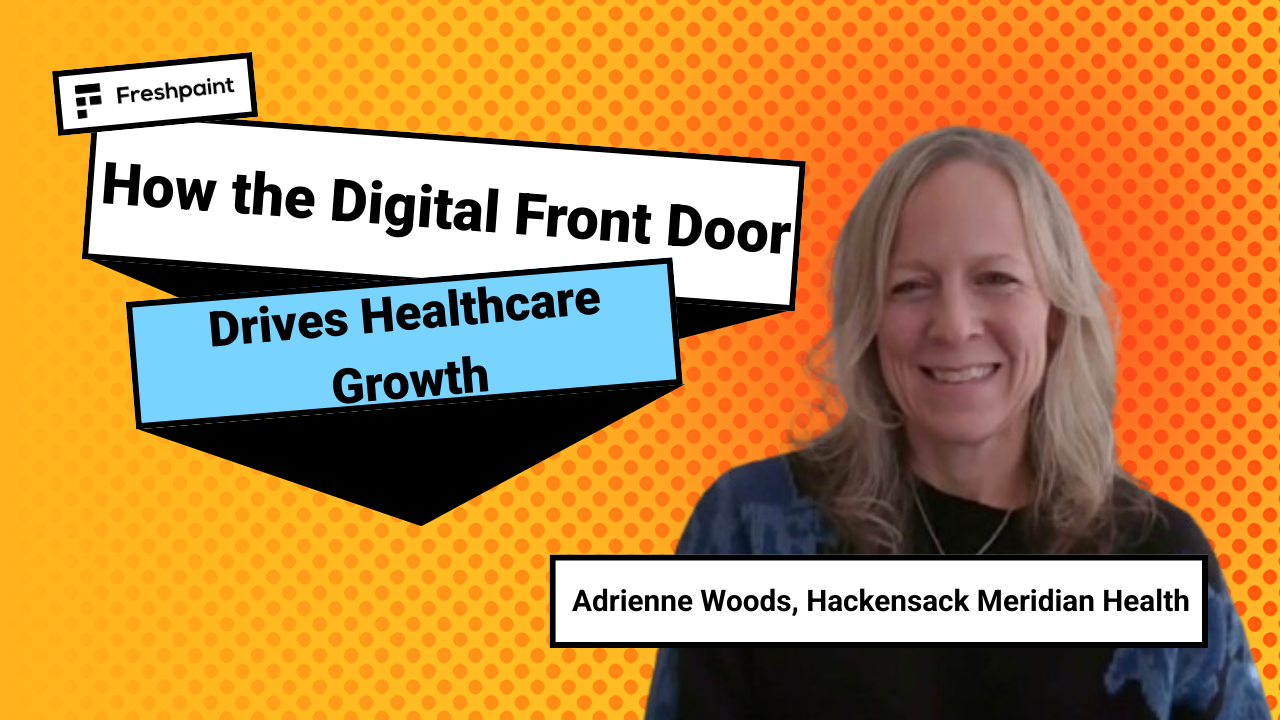

Healthcare marketers have spent years talking about the digital front door. Most of that conversation has centered on user experience—making things easier, reducing friction, meeting consumer expectations.
That framing misses the point entirely.
The digital front door isn't a UX nice-to-have. It's foundational infrastructure for measurable growth. It's the difference between knowing your cost per click and knowing your cost per attended appointment. Between tracking impressions and tracking revenue. Between hoping marketing drives patient volume and proving it does.
Adrienne Woods has built one of the most sophisticated digital front door strategies in healthcare at Hackensack Meridian Health. But what makes her approach different isn't the technology stack or the consumer-facing polish. It's that she's connected every dot from initial interest to booked appointment to attended visit—and used that visibility to turn marketing into a genuine growth engine for a 17-hospital system.
Her conversation with Freshpaint CEO and Marketing Rounds host Ray Mina wasn’t about making websites prettier. It's about building the connective tissue that lets you see what actually works, optimize for real outcomes, and prove marketing's impact on revenue.
1. Time on Page Doesn't Pay the Bills—Attended Appointments Do
Most healthcare marketers are tracking the wrong metrics. Impressions, time on page, bounce rate—these tell you whether your campaign created awareness. They don't tell you whether it drove revenue.
This isn't just an academic distinction. When you optimize for soft metrics, you optimize for the wrong outcomes. You celebrate campaigns that look successful in Google Analytics but generate zero patient visits. You spend months improving page engagement without moving the needle on appointments.
You report "wins" to leadership that have no business impact.
Adrienne's team redefined success around a single question—did we get the right person to the right physician at the right time? Everything else became noise. "Until we started saying, what is a real call to action to measure success, and measuring success is getting the right person to the right physician at the right time, you can't get that from time on page, how many pages they visited, bounce rate," Adrienne said. "It's the call to action and getting that patient in the front door that matters."
This required ruthlessly simplifying their measurement framework. Instead of tracking dozens of engagement signals, they focused on conversion events that actually indicated patient acquisition: booked appointments, arrived appointments, new patient visits.
The shift sounds obvious. But it required infrastructure most organizations don't have—the ability to track a consumer's journey from first click through scheduling system entry through EMR arrival confirmation.
Most healthcare marketers lose visibility somewhere between the website form and the actual appointment. That gap makes it impossible to optimize for real outcomes.
What this means for you:
Audit what you're currently optimizing for. If your primary KPIs are website-level metrics—page views, session duration, form fills without appointment confirmation—you're flying blind on what matters most.
The hard work isn't choosing better metrics. It's building the systems to track them.
Start by mapping where visibility breaks down in your current funnel:
- Can you see from paid ad click to booked appointment?
- From booked appointment to arrived appointment?
- From first visit to return visit?
Those gaps represent decisions you're making without data.
2. Your Campaigns Can't Convert Without the Right Infrastructure
The most common waste in healthcare marketing isn't failed campaigns. It's successful campaigns that drive traffic to experiences that can't convert.
For example, imagine you run a campaign promoting a new orthopedic location. The ad performs beautifully—strong CTR, good engagement, people are clicking. But the call to action leads to a general "find a doctor" page with 400 orthopedic surgeons. No online scheduling. No clear next step.
This scenario happens more than we like to admit. The consumer does the work to find care, then hits a wall.
The uncomfortable truth about this? That's not a conversion problem. That's a product problem. And most organizations treat it as someone else's problem to solve. But Adrienne refuses to pass the buck.
Her team has made the call to action non-negotiable. If a campaign promises something—book an appointment, find a specialist, schedule care—the landing experience must deliver it without additional friction.
"If we make that consumer experience the way it should be, and it's not hard, take that person to orthopedic surgeons at Hackensack Meridian Health that have online schedulable appointments to make it seamless," she explained. "If you provide a call to action that allows them to complete the action that they have in their mind, that they want to do, you're gaining their trust and then they will continue to utilize your services."
This required coordinating with physician practices to ensure online scheduling availability before launching campaigns. It meant turning off marketing to service lines that couldn't deliver on the promised experience.
It forced uncomfortable conversations with providers about capacity, access, and what happens when demand exceeds supply.
What this means for you:
Every campaign should start with the question: can we actually deliver what we're promising? If someone clicks this ad, can they immediately book an appointment with the physician we're promoting? If not, either fix the experience or don't run the campaign.
This isn't about perfection. It's about intentional constraint. Better to market fewer services excellently than market everything poorly.
Adrienne's team will redirect campaigns to satellite locations with availability rather than promote the main campus where wait times are 30+ days. They prioritize conversion over volume.
If you want to follow their lead, here’s the tactical move: Before launching any paid campaign, walk through the exact consumer journey yourself. Click the ad. Try to complete the action. If you encounter friction—unclear next steps, phone-only scheduling, providers without availability—stop and fix it first.
3. Close the Gap Between Digital Engagement and Patient Encounters
Ready for another uncomfortable truth? Most healthcare marketers can tell you how much they spent to generate a form fill. Very few can tell you how much they spent to generate an attended appointment.
That gap—between digital engagement and actual patient encounter—is where most optimization dies. You make decisions about channel performance, creative effectiveness, and budget allocation based on proxy metrics that may or may not correlate with real outcomes.
The result? You over-invest in channels that look efficient at the top of funnel but convert poorly to appointments. You under-invest in channels that seem expensive but drive high-intent patients who actually show up. You report cost per lead to leadership without knowing if those leads became patients.
To eliminate the gap, Adrienne's team built infrastructure to track conversions all the way through to attended appointments, then used that visibility to make fundamentally different decisions. "If we can show that mammography appointments go up at the locations where we are sending text messages, that is showing true value in offering these digital solutions," she said.
The ability to close that loop—from campaign to scheduling action to appointment completion—changed what they could prove and therefore what they could justify investing in.
This required integrating campaign tracking with their scheduling system and eventually their EMR. It meant working with IT to build data pipelines that most healthcare organizations don't have. It forced them to clean up provider data, standardize appointment categorization, and build reporting that connected marketing dollars to patient revenue.
The result isn't perfect attribution. But it's clear enough to make better decisions—which channels drive appointments that stick, which campaigns generate patients who return, which service lines convert digital interest into actual visits.
What this means for you:
You don't need perfect attribution to start making better decisions. But you do need visibility past the website. The minimum viable version is to connect your digital analytics to your scheduling system so you can see booked appointments, not just form fills.
Work with your IT and operations teams to answer these questions:
- Can we track from campaign click to booked appointment?
- Can we differentiate new patient appointments from established patients?
- Can we see cancellation and no-show rates by traffic source?
- Can we eventually connect appointments to actual visits and revenue?
Each layer of visibility unlocks new optimization opportunities. Start with what's possible now, then build toward more comprehensive tracking.
4. Full-Funnel Visibility Changes Who Owns the Problem
The most common frustration in healthcare marketing: "I drove all this demand, but operations couldn't handle it." Long wait times. Poor phone answer rates. Providers at capacity. Marketing gets blamed for driving volume the system can't absorb.
That dynamic exists because marketing lives in a different data universe than operations. Marketing sees campaign performance. Operations sees patient volume and capacity utilization. Nobody sees the connection between the two—or takes ownership of the gap.
When Adrienne's team could show exactly how marketing spend translated to appointment demand, it changed the nature of every conversation with operations partners.
She described playing calls with the contact center: "This wasn't a patient on the phone. I said, we're here to deliver quality care. I get what our why is great patient care. But in this conversation, this is a lead. We paid money to make the phone ring. So if we don't book them, we have lost the moment."
That shift—from "we drove traffic" to "we created a lead that has measurable value"—gave marketing a seat at the operational table. It let them have data-driven conversations about capacity planning, scheduling optimization, and access improvement.
More importantly, it let them influence supply-side decisions. When certain providers consistently had 30-day wait times, Adrienne's team could quantify the revenue being left on the table. They could show that "patients will wait to see me" actually meant "delayed revenue capture" or "lost patients to competitors."
Armed with that data, they implemented travel policies to move providers between locations based on demand. They adjusted marketing spend to satellite locations with better availability. They built feedback loops between campaign performance and operational capacity.
What this means for you:
Marketing can't solve operational constraints. But when you have full-funnel visibility, you can make those constraints visible and quantifiable—which forces organizations to address them.
So stop positioning marketing as separate from operations and position it as the growth engine that depends on operational excellence to convert demand into revenue instead. Use data to show leadership the cost of operational friction—not in vague terms, but in specific lost appointments and delayed revenue.
Practically, this means building reporting that shows:
- Campaign performance: cost per lead, cost per appointment request
- Conversion performance: lead-to-appointment rate, appointment-to-arrival rate
- Operational performance: wait times, phone answer rates, online scheduling availability
- Revenue impact: patient volume, new patient acquisition, service line growth
When all four are visible in the same dashboard, it becomes obvious where the bottlenecks are—and whose problem it is to fix them.
The Transformation Healthcare Marketing Must Make
The digital front door isn't a website redesign project. It's not a mobile app launch. It's not even a technology initiative.
The digital front door is the infrastructure that connects marketing investment to patient revenue. It's the visibility that lets you optimize for outcomes that matter. It's the data foundation that turns marketing from a cost center into a measurable growth engine.
Most healthcare organizations aren't there yet. They're still tracking impressions and hoping those translate to patient volume. They're still running campaigns without knowing if those campaigns generate appointments. They're still making million-dollar budget decisions based on incomplete data about what actually works.
The organizations that close these gaps—that build the connective tissue between digital engagement and patient encounters—will have an enormous competitive advantage. Not because their websites are prettier or their ads are more creative. Because they can see what drives real outcomes, invest accordingly, and prove their impact on revenue.
That's the transformation Adrienne Woods described. And it's the transformation healthcare marketing must make to justify its seat at the growth table.
Experience the full conversation where Adrienne breaks down the Four A's framework (Acquire, Activate, Access, Adoption), how Hackensack Meridian Health thinks about privacy as a strategic advantage, and why the next frontier is AI-driven search and provider data accuracy.





.png)