Why Indiana University Health Stopped Optimizing for the First Appointment
.png)



Anatomy of a Campaign is a Freshpaint series that takes you inside real healthcare marketing campaigns – breaking down the strategy, execution, and measurement behind what made them work. In each edition, we deconstruct a real-world campaign so you can:
- Understand the strategic thinking behind it
- See how it was activated
- Learn how performance was measured
- Walk away with practical, transferable insights for your own campaigns
Most healthcare marketing campaigns start with the same assumption: the goal is to get people in the door.
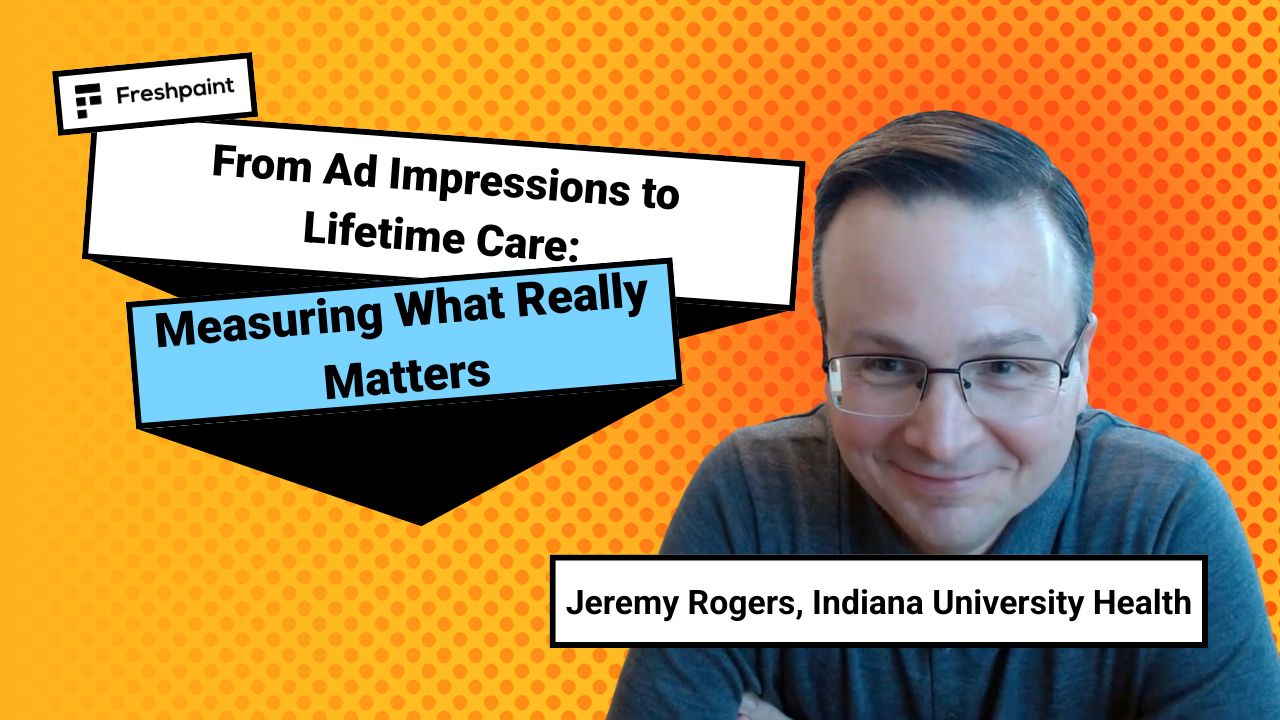
But Jeremy Rogers, Indiana University Health’s VP of Digital Marketing and Experience, has spent years asking a deeper question: once someone becomes a patient, are we continuing to win their care? That framing reshapes how IU Health thinks about channel investment, measurement, internal alignment, and what growth actually means.
This edition of Anatomy of a Campaign breaks down the strategic shift Jeremy’s team made, away from acquisition-first marketing and toward a full-lifecycle model that connected marketing spend to the outcomes finance and clinical leaders actually care about.
Want to hear the story in Jeremy’s words? Check out his episode on our Marketing Rounds podcast, hosted by Freshpaint CEO Ray Mina.
Anatomy of the Campaign
The Market Context
- Scope: Statewide health system serving all of Indiana’s urban, suburban, and rural markets
- Challenge: Drive sustainable growth across the full patient lifecycle while clinics operate near capacity.
Post-pandemic, IU Health faced a dynamic that's been reshaping healthcare marketing across the country: the supply-demand curve had flipped. Many clinics were already full, and thus unwise to be on the receiving end of a net-new patient acquisition campaign.
But the growth imperative didn't go away. It shifted toward patients who generate downstream value via procedures, specialty care, and chronic disease management. These patients were already in the system. They just weren't being marketed to.
That’s why Jeremy and his team rebuilt their strategy around owning those in-between moments of care.
Inside the Campaign's Growth Engine:
- Strategy reframed from single-funnel acquisition to a series of lifecycle conversion opportunities
- Channels matched to patient segment and geography
- First-party data connected EHR, CRM, and consumer behavioral signals to identify in-market moments
- Measurement elevated from first appointment to NPS, share of wallet, and long-term LTV
1. Campaign Objective: Own the Full Patient Lifecycle, Not Just the First Visit
Goals for IU Health's marketing transformation were:
- Sustainable patient growth tied to downstream capacity
- Higher lifetime value per patient
- Strong share of care
- Measurement that finance and clinical leaders could act on
- A first-party data foundation that compounded over time
2. Audience Strategy: Segment by Moment, Not Just Demographics
The objective was clear: stop treating all patient acquisition campaigns as equal and start identifying the specific moments when patients are most likely to need, and be receptive to, a particular service.
The team built segmentation using behavioral and psychographic data layered on first-party records, including:
- Propensity models predicting which patients are likely to seek specific services in the near term
- Lookalike audiences built from high-value patient profiles
- Claims data augmenting first-party records to identify share-of-wallet gaps
- Geographic nuance across Indiana's diverse urban, suburban, and rural populations
Most patients are only in market for a specific healthcare service a handful of times per year. But health systems have more data about their customers than nearly any other industry, yet many tend to let the relationship go dark between appointments rather than using those signals.
"Every time a patient is seeking care, you're putting them through a new conversion funnel. You've got the benefit of having that relationship with them. The goal is to win it every time." — Jeremy Rogers
3. Channel Strategy: Match the Channel to the Care Decision
Paid search remains a piece of the puzzle. But not all care decisions start with a Google search, and not all patients are reachable the same way. Jeremy's team developed a channel approach that matches activation to market conditions and patient segment:
- Paid search and Local Search Ads to capture high-intent demand across all markets
- Direct mail in rural markets where digital penetration is lower, with geographic proximity logic built in; no value in promoting a clinic someone can't reach
- Community and faith-based partnerships in rural and underserved areas, where trusted local institutions outperform digital channels for awareness
- Virtual care promotion in remote geographies. Counterintuitively, patients 90 minutes from the nearest clinic often over-index on virtual visits
The through-line: channel selection follows market conditions, not historical spend patterns.
4. Data Infrastructure: Build the Plumbing First
A full-lifecycle strategy requires connecting signals across systems that weren't designed to talk to each other: EHR data, CRM, billing records, and consumer behavioral data generated before someone becomes a patient.
IU Health has invested in its data infrastructure continuously for over ten years. That infrastructure is what makes everything else possible.
"If the EHR is the source of truth for care data, you still have everything that happens before a patient becomes a patient, and everything after a care episode.” — Jeremy Rogers
This investment requires ongoing maintenance of integrations, data quality, and schema — including, increasingly, ensuring that structured provider and location data is readable by the AI agents patients are beginning to use to navigate care decisions.
As a result of IU Health’s long-term investment in its data infrastructure, Jeremy and his team were equipped to identify patients between episodes of care, activate them with targeted campaigns, and connect acquisition to downstream care outcomes – the full chain of evidence needed to prove marketing’s contribution to growth.
5. Measurement: Retire Last-Click. Track the Lifecycle
The measurement model at IU Health is built around a simple premise: a booked appointment is not a final conversion. It's a leading indicator.
IU Health tracks performance across the full patient lifecycle:
- Appointment booked
- Patient showed
- Service delivered
- Downstream care accessed (specialty, procedures, chronic care)
- Care gap closure
- Share of care retained within the network
The KPIs that matter to leadership:
- NPS, which sits on IU Health's corporate scorecard as one of the organization's top four enterprise metrics
- Share of wallet/share of care, measured using first-party data augmented by claims data, to track whether patients are going elsewhere between episodes
- Lifetime value at the patient segment level, to understand which acquisition sources generate durable relationships vs. one-time visits
6. Organizational Alignment: Make Finance a Partner
Connecting acquisition to downstream outcomes requires marketing, IT, finance, and clinical operations to work from the same data toward the same goals.
Jeremy's approach:
- Find champions with shared growth incentives. Marketing can't make this case alone. The most effective path is identifying service line leaders and operational stakeholders who are directly incentivized by the same growth. Multiple voices making the same case to IT or finance changes the conversation.
- Speak the CFO’s language. Marketing's job is to drive strategic growth. That means acquiring and retaining the right patients, and delivering them to care teams that can serve them. If you can show real, traceable ROI, you earn incremental investment.
Set long-term expectations up front. The data infrastructure required for lifecycle marketing is an annuity, not a project, and one that has continued to pay dividends over its 10-year investment. Setting that expectation honestly is part of getting the buy-in to start.
What This Campaign Proves
IU Health's transformation illustrates what happens when a health system stops treating marketing as a lead generator and starts treating it as a growth architecture.
The lesson is that growth comes from a disciplined model that aligns marketing, operations, and finance around long-term patient value. And that model requires building the data foundation before you can prove it.
From this transformation, Jeremy distills three actions health system marketers can take today:
- Start measuring micro-conversions now. If you can't connect the full funnel yet, identify what you can track. Maybe it’s appointment completions, return visits, or service-line transitions. Then start building the story. Partial attribution is better than last-click.
- Build your first-party data strategy. Map your data sources. Identify the gaps between EHR, CRM, billing, and consumer behavioral data, and begin activating internal champions with shared goals to help enable data linkage.
- Define what growth actually means for your organization. Not all patient volume is equal. Get specific about which segments have the highest LTV, which service lines have the most compelling downstream margin story, and where your share of care is leaking. Let those answers drive channel allocation.
Together, these three moves can shift marketing from filling schedules to driving the growth that actually matters to your CFO.
Now It’s Your Turn
Go deeper on how to build a scalable, multi-channel growth engine to improve marketing performance, increase revenue growth, and prove impact:
- Get the step-by-step framework to go beyond search in our ebook, Beyond Google: The Multi-Channel Playbook for Healthcare Marketers.
- Copy the playbook of another enterprise health system, Hackensack Meridian Health, which connected every dot from initial interest to booked appointment to attended visit—and used that visibility to turn marketing into a growth engine for its 17-hospital system.
- Check out our Anatomy of a Campaign on how a dental practice more than doubled new patient growth with a geographic disruption campaign





.png)