Are You Converting the Most Expensive Page on Your Website?

It’s the end of the quarter and you’ve poured six figures into Google Ads. But when you run the numbers, ROI has barely improved.
You’re not alone — many healthcare marketers are investing a large portion of their budget in PPC and spending months optimizing for more clicks. But if the landing page you’re directing ad traffic to isn’t converting, that effort is wasted. It’s like changing the tires on a car when the problem is a faulty engine.
Visibility into what happens after the click remains one of the biggest blind spots in healthcare marketing.
Traditional analytics tell you how much traffic a campaign generated, but not where patients abandon a form, what causes hesitation, or which web experiences are loading so slowly that a patient leaves your site. Answering these questions often requires teams to stitch together data across analytics tools, heatmaps, replay platforms, and spreadsheets (assuming those tools can safely operate on PHI-sensitive pages).
That’s why we’re seeing sharper conversion rate optimization (CRO) capabilities emerge as one of the most effective ways for healthcare organizations to derive greater value from existing traffic — and improve performance without increasing spend.
What's Actually Happening on the Page
Let’s break this down with a simple example. Say you’re driving 10,000 clicks at a cost per click (CPC) of $6 (the 2025 industry average), costing you $60,000. A $6 CPC might seem reasonable, but if your landing page has a 1.2% conversion rate, those 10,000 visits only yield 120 appointments. Based on the total investment, you’re paying $500 for every booked appointment in ad costs alone.
It’s not that you think the post-click journey is unimportant. But when you don’t have visibility into how it’s working, you can’t measure and improve it.
When it comes to measuring and optimizing on-page conversions, healthcare marketers have traditionally been held back by a few things:
- Treating paid search metrics like CPC as the endpoint, instead of measuring what happens after visitors land on your website. Marketers can spend months improving Quality Score, but those optimizations won’t reveal that a patient couldn’t find the appointment form, abandoned the page out of confusion, or left before the page fully loaded.
Healthcare teams have become highly effective at optimizing the systems they can measure. The challenge is that most still lack visibility into the full journey between the ad click and the conversion.
- Avoiding behavioral tracking on PHI-sensitive pages due to compliance risk. Landing page engagement data can qualify as protected health information (PHI), especially when form inputs, URL strings, or page content containing medical information are captured alongside identifiers like IP address, device ID, or email.
With the regulatory landscape becoming increasingly complex — Kaiser Permanente, for example, agreed to pay up to $47.5 million in 2024 to settle a class action over its use of tracking technologies — many health systems are prioritizing regulatory safety over marketing measurement. As a result, healthcare marketers are often left with partial visibility spread across multiple systems, making it difficult to confidently diagnose where conversion journeys break down. - Optimizing only the parts of the funnel you can safely measure (like keywords, bids, and ad creative), because understanding the landing page experiences requires too many fragmented tools. Unfortunately, this shields insights around the high-leverage conversion opportunities that are often happening after the click, inside appointment flows, intake forms, and other PHI-sensitive journeys.
- Treating the conversion gap as a creative problem, versus a data problem. The first instinct for landing page optimization is to start changing the page. Hire a designer, rewrite the copy, even A/B test the CTA color.
But the reason healthcare landing pages underperform isn't that they look bad or read poorly — it’s that nobody knows the source of failure. Without data on how users are interacting with the page and where they’re getting stuck, it’s impossible to make informed decisions and measure the results of your changes.
What Happens When Post-Click Behavior Becomes Visible
For years, healthcare marketers trying to improve conversion rates have been forced to piece together insights across analytics platforms, heatmaps, replay tools, spreadsheets, and feedback systems — often without visibility into the PHI-sensitive parts of the journey that matter most.
Modern CRO requires more than fragmented data points. It requires an end-to-end view of how patients actually move through the conversion journey, and the ability to turn that view into clear action. Of course, most marketers already have more data than they can act on. The challenge is turning fragmented signals into clear, trustworthy decisions before another week goes by.
AI is supposed to solve for this… But most AI tools sit on top of incomplete, disconnected datasets, producing generic recommendations that marketers can’t fully trust — especially in healthcare, where privacy constraints limit what data can safely be collected and activated.
AI Insights Are Only as Good as the Data Behind Them
Freshpaint solves the hard part first: We capture, structure, and govern healthcare marketing data under HIPAA and BAA requirements so our AI has a reliable foundation to work from. Instead of relying on partial signals or assumptions, Freshpaint AI is grounded in real user behavior across the patient journey.
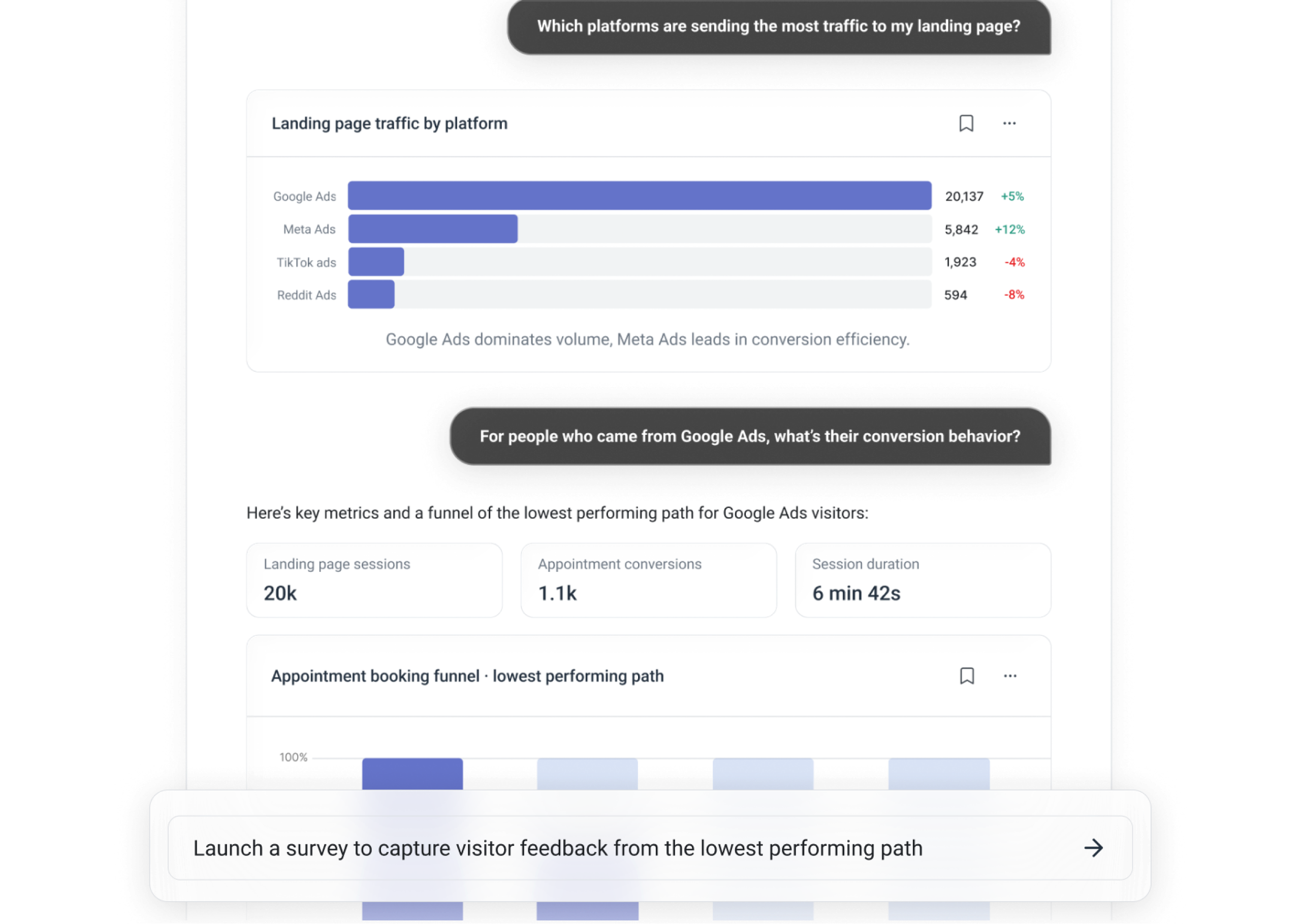
With connected data across every channel, healthcare marketers are using our AI to surface revenue-enhancing insights, in seconds: where web conversion journeys are breaking down, which issues are impacting conversion most, and what marketers should do next. It identifies patterns, prioritizes opportunities, and eliminates hours of manual analysis across disconnected tools.
Ask a plain-language question, and Freshpaint AI tells you where conversion is slipping, why it’s happening, and what to fix next. Not a summary of your dashboard. A clear next step.
See What Faster Decision-Making Looks Like
That shift from fragmented investigation to focused action with Freshpaint AI is showing up directly in how teams work and what they're able to accomplish.
Early users of Freshpaint CRO capabilities report:
- “We can’t do this conversion rate optimization without Freshpaint.” — Marketing leader at a large regional payer, which was going to build similar capabilities themselves before seeing Freshpaint’s in action
- “I know I said this would save 3 hours, but this is actually saving me weeks.” — Digital marketing leader at a healthcare organization
- “We have two other vendors who have rolled out in-platform AIs, and this is by far the best.” — Marketing analytics leader at an academic health system
- "A 1-2% improvement equals huge numbers for patient acquisition. We're protecting our paid media investment through optimization." — Leader at a DSO with 100+ locations
After the Click, Reimagined
Now imagine the same health system, still spending $60,000 per month to drive 10,000 visits — but this time with full visibility into what happens after the click.
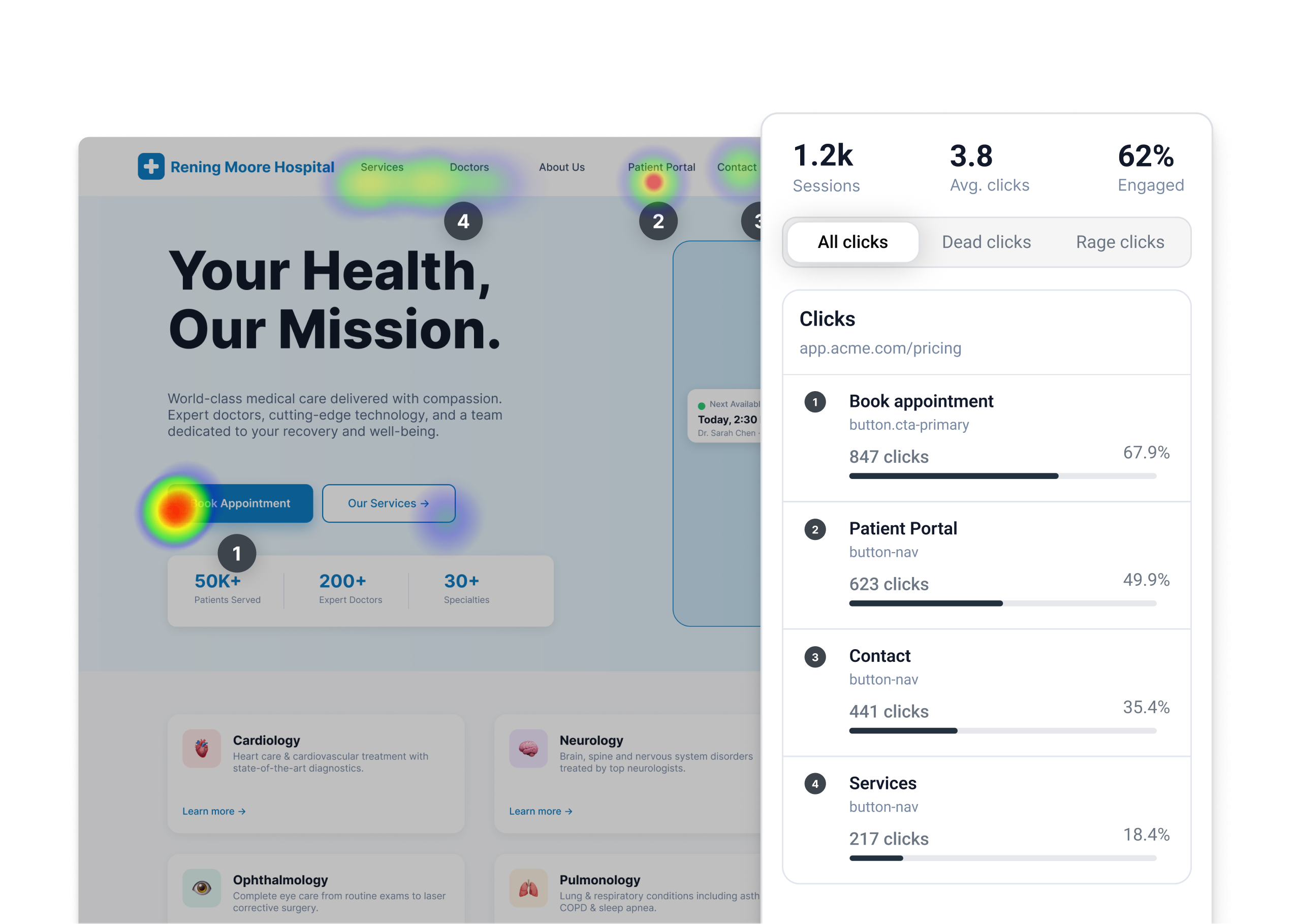
Instead of jumping between disconnected tools and manually stitching together insights, the marketing team can investigate the conversion journey from one connected workflow: funnels that show exactly where visitors drop off, heatmaps that reveal what’s driving engagement or confusion, session replays that surface hesitation and friction, and Freshpaint AI that helps explain why patients aren’t converting.
The downstream impact goes further than time saved. Catching drop-off points and launching data-driven page optimizations improve conversion rate from 1.2% to 2% and decrease cost per appointment from $500 to $300 — resulting in 80 additional appointments per month on the same $60,000 ad spend.
Conversion Rate Optimization Capabilities Built for Healthcare
Marketers in other industries have had access to this kind of optimization tooling for years. But healthcare organizations face a unique challenge: the most valuable conversion journeys often involve PHI-sensitive experiences where traditional CRO tools can’t safely operate.
That leaves teams with fragmented visibility and limited confidence in what’s preventing patients from converting.
Freshpaint’s CRO capabilities were built specifically for the healthcare performance and compliance environment. By bringing together analytics, funnels, heatmaps, session replay, and AI within a HIPAA-compliant, BAA-backed platform, healthcare marketers can investigate the journeys that matter most without relying on fragmented tools or manual analysis.
Instead of spending hours analyzing fragmented data, teams can quickly identify and act on what matters most:
- Identify where users abandon key journeys
- Understand what’s creating abandonment
- Prioritize fixes based on real behavior
- Improve conversion without increasing media spend
Your Most Expensive Pages Should Also Be Your Highest-Converting
Healthcare marketers have spent years optimizing traffic acquisition because that’s where the visibility existed.
But the next wave of performance gains won’t come from cheaper clicks alone. They’ll come from understanding what happens after the click — and systematically removing the blockers that prevent patients from converting.
Ready to get more value from the traffic you’re already paying for?
Book a demo or connect with your account manager to see how Freshpaint CRO helps healthcare marketers improve conversion, move faster, and optimize the journeys that matter most — without increasing spend.


.png)