Healthcare Marketing's Playbook for the 2027 Medicaid Changes
.jpg)



Hospitals and health systems are entering 2027 after several years of sustained financial pressure from rising labor costs, persistent reimbursement challenges, inflation, and shifting payer mix. While patient volumes have stabilized since the height of the pandemic, margins remain tight and executives continue to face difficult decisions about where to invest for growth and areas to reduce costs.
Now, changes to Medicaid financing will add another layer of uncertainty.
Beginning in 2027, the federal government will start tightening several financing mechanisms that states have historically used to support Medicaid reimbursement, including provider taxes and state-directed payments (SDPs). While these changes won't result in immediate, across-the-board Medicaid rate cuts, they will gradually reduce states' flexibility to supplement provider payments, creating additional financial pressure for many hospitals and health systems.
For healthcare marketers, this matters because marketing budgets are often among the first places executives look when revenue becomes uncertain.
Marketing sits at the intersection of patient demand, digital behavior, clinical operations, and revenue. Few departments have as much visibility into how patients discover, choose, and engage with care. That makes marketing uniquely positioned — not just to weather the coming reimbursement pressure, but to help health systems respond to it. Of course, as financial pressure increases, executives are asking every department to demonstrate measurable business value. Marketing is no longer judged on awareness or lead generation; it is expected to show how its investments contribute to patient acquisition, revenue growth, and organizational priorities.
Many organizations haven't fully made that transition yet. In Freshpaint's recent survey of 200 healthcare marketing leaders, only 37% said executive leadership views marketing as a strategic growth driver. Nearly 20% said leadership still sees marketing primarily as a cost center. At the same time, only 1% of organizations can connect more than half of their marketing spend to meaningful business outcomes, making it difficult to defend budgets when financial pressure increases. The organizations that weather the coming reimbursement changes most successfully won't necessarily be the ones that spend less on marketing. They'll be the ones that can clearly demonstrate which marketing investments drive patients, revenue, and long-term growth.
There are practical steps healthcare marketing teams can take today to strategically direct and connect marketing’s contribution to organizational growth.
From improving attribution and optimizing channel mix to aligning more closely with service line leaders, the work that leaders do over the next 12-18 months can put their organizations in a much stronger position before reimbursement pressures intensify. This blog post outlines exactly how to do so.
Key Takeaways
- The 2027 Medicaid financing changes will increase pressure on hospital margins, making it even more important for marketing teams to demonstrate measurable business value.
- The organizations that emerge strongest will be the ones that invest in the capabilities that prove, optimize, and scale marketing's contribution to growth.
- Preparing for 2027 starts now. By improving measurement, aligning with organizational priorities, and modernizing marketing infrastructure, healthcare marketers can become strategic growth partners rather than discretionary cost centers.
What to Expect From the 2027 Medicaid Changes
Several Medicaid financing changes begin taking effect in fiscal year 2027 that will gradually reduce the flexibility states have relied on to support provider reimbursement.
Key changes include:
- Provider tax limits tighten. States have historically used provider taxes to draw additional federal Medicaid matching dollars. Existing programs are frozen, new arrangements are prohibited, and allowable provider tax rates gradually decline from 6% toward 3.5% in affected states over the coming years.
- State-directed payments (SDPs) face lower caps. New Medicaid managed care directed payments will be limited to 100% of Medicare rates in Medicaid expansion states and 110% in non-expansion states.
- Grandfathered payment arrangements begin phasing down. While some existing SDPs remain protected through 2027, many begin stepping down in 2028 until they reach the new federal limits.
- State budgets are already adjusting. Many states are incorporating these changes into FY2027 budget planning, anticipating increased pressure on supplemental Medicaid funding and provider reimbursement.
What does all this mean in practice? For most health systems, 2027 won't feel like an immediate reimbursement cliff. Instead, it marks the beginning of a multi-year financial squeeze as states lose many of the mechanisms they've historically used to keep Medicaid payments elevated.
What Freshpaint Is Hearing From Healthcare Leaders
Many of the health systems Freshpaint speaks with are modeling revenue pressure in the 5-10% range as they prepare for changes in Medicaid financing. This could be a harbinger of resource constraints for the many marketing teams that still struggle to prove their financial impact:
- Our recent research found that 49% of healthcare marketers believe they consistently improve ROI, but only 1% can actually connect more than half of their marketing spend to patient outcomes.
- Most organizations can only connect 10-25% of their spend to measurable business results.
That measurement gap becomes especially risky during periods of financial uncertainty. When executives can't clearly see which marketing investments produce appointments, downstream revenue, or long-term patient value, those investments become much easier to reduce. The opportunity for healthcare marketing leaders today isn't simply to protect marketing budgets — it's to change the conversation entirely. It’s a moment to take a cue from teams that treated the 2022 HHS guidance as a moment to re-evaluate digital marketing and analytics, rather than simply shut down pixels.
The Impact on Health Systems Goes Beyond Medicaid Revenue
Health systems will continue to face increasing pressure to improve operating margins while simultaneously maintaining patient access, growing higher-margin service lines, recruiting physicians, and competing for commercially insured patients. That means every department, including marketing, will have greater expectations to prove value.
Of course, healthcare marketing leaders are already used to operating in this environment. According to Freshpaint's State of Healthcare Marketing 2026 report:
- 87% of healthcare marketers say their first response to budget pressure is improving the efficiency of existing spend rather than cutting campaigns.
- 57% are investing in analytics and attribution tools to better understand what's driving patient acquisition.
- Only 37% say executive leadership currently views marketing as a strategic growth driver.
Those numbers point to a broader shift in healthcare.
The conversation is no longer about whether marketing can generate leads. It's whether marketing can help health systems make smarter operational decisions, such as: how to align service line growth to patient demand, recruit patients with the ideal payer mix, and turn campaigns into measurable downstream revenue. The organizations that can answer those questions with data will be in a much stronger position as reimbursement pressure increases.
The next 12 to 18 months represent an opportunity to strengthen marketing's position within the organization.
Keep reading for practical steps for healthcare marketing leaders to enter the coming budget cycle with a strong story grounded in business outcomes.
A Nine-Point Action Plan for Healthcare Marketing Leaders, Before the 2027 Medicaid Changes
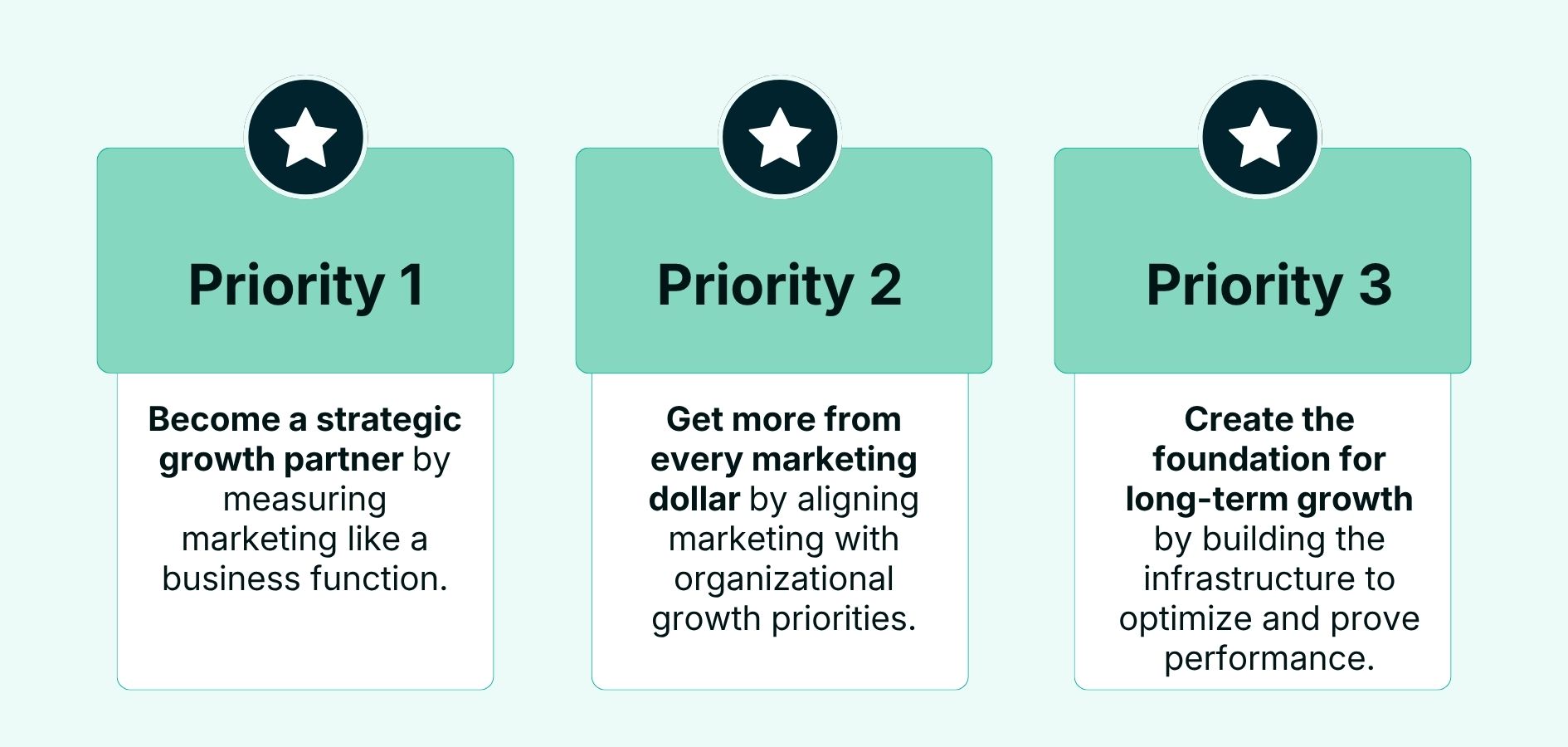
Preparing for Medicaid changes is about making three strategic shifts in how marketing measures, aligns, and plans. Based on our conversations with leading healthcare marketers who are actively contributing growth and shaping business priorities, teams should focus on three strategic priorities:
- Priority 1: Become a strategic growth partner by measuring marketing like a business function.
- Priority 2: Get more from every marketing dollar by aligning marketing with organizational growth priorities.
- Priority 3: Create the foundation for long-term growth by building the infrastructure to optimize and prove performance.
Priority 1: Become a Strategic Growth Partner
- Tie every marketing dollar to patient growth.
The days of defending campaigns with impressions, clicks, or even leads are fading. CFOs want to know one thing: Which investments generate patients, support priority service lines, and contribute to revenue? This is an opportunity for marketing leaders to reposition themselves as growth leaders rather than budget owners. Start by mapping every major marketing investment against a measurable business objective. Your goal is to be able to answer questions, like:
- Which campaigns support high-margin service lines?
- Which drive appointment volume?
- Which have a demonstrable impact on downstream revenue?
If you can't answer those questions, now is the time to build the measurement needed to do so. That point is especially important for upper-funnel investments. Awareness channels like CTV, programmatic, and brand campaigns often influence patients long before they convert, but traditional attribution models frequently fail to give them credit. The problem isn't marketing strategy; it's measurement infrastructure.
Organizations that build that visibility are far better positioned to optimize budgets strategically instead of making cuts based on incomplete data. Before cutting spend or considering eliminating channels, we encourage marketers to ensure you have the ability to accurately measure the contribution of each investment on the full patient journey. In an environment where every dollar matters, the ability to prove marketing's contribution to growth may be just as valuable as the campaigns themselves.
- Focus patient acquisition where it matters most.
Two realities make this an opportunity for healthcare marketers.
- Most health systems already collect and analyze data on payer mix, referral patterns, service line performance, and capacity to inform strategic planning and growth decisions. The gap is often bridging those insights into marketing — versus leaving them confined to strategic planning, finance, or operations — to shape where marketing invests, which communities it reaches, and how campaigns support the organization's highest-priority growth initiatives.
- Second, healthcare is local. Patients typically begin their search for care close to home, creating an opportunity for marketers to connect communities with nearby providers, urgent care centers, specialty clinics, and other points of access.
The opportunity lies at the intersection of these two realities. The most effective healthcare marketers will combine organizational data with hyperlocal campaigns to drive growth in the service lines, geographies, and patient populations that matter most to their organization. As they invest more in community-based marketing, they'll also need privacy-safe measurement that connects campaigns to appointments, reveals performance across neighborhoods and service lines, and enables budget decisions based on patient acquisition patterns.
- Solve the problems your service lines are actually trying to solve.
The highest-performing healthcare marketing teams don't just generate demand, they also help solve business problems. That starts with going beyond the surface with service line leaders. The best marketing teams don't ask, "How do we generate demand?" They ask, "What's keeping this service line from growing?" Sometimes the answer is patient volume. But just as often it's physician recruitment, low utilization of a new facility, poor preventive screening rates, referral leakage, or patients failing to return for follow-up care. Each challenge calls for a different marketing strategy.
OU Health in Oklahoma provides a great example. Rather than simply promoting cancer screenings to the broad public, the team worked across clinical, operational, and marketing departments to identify patients at elevated risk, connect them with the appropriate screening programs, and improve access through mobile screening initiatives. Marketing wasn't just generating awareness; it became part of the organization's population health strategy.
As margins tighten, marketing leaders who solve operational problems will position themselves as stronger growth drivers at the executive table.
Priority 2: Get more from every marketing dollar.
- Get more conversions from the patients you're paying to reach.
If your marketing budget is reduced or stays flat next year, you'll have two choices: generate more patient volume with less budget, or generate more value from the budget you have. The second option is often easier than marketers think, when you start looking into:
- How many patients abandon the appointment booking process?
- Which service line pages have the highest drop-off rates?
- Where do patients get stuck online trying to find a provider?
- Is your mobile experience making it harder to schedule care?
Every one of these friction points represents patients you paid to attract and failed to convert into appointments. Most healthcare marketing teams are flying blind between the click and the booked appointment. They know which campaigns generated traffic, but they don't know why patients leave without taking the next step. That often leads organizations to spend more on advertising when the bigger opportunity is simply fixing what's already broken.
The highest-performing organizations treat their website like any other part of the growth engine. They:
- Regularly review where patients drop off
- Watch how users navigate key journeys
- Collect patient feedback, and,
- Continuously remove friction from the booking experience.
This is made even easier with AI tools in your healthcare marketing platform that surface friction points automatically. The result is a lower cost to acquire each patient because more of the traffic you’ve paid for converts.
- Connect your marketing reporting to business outcomes — and put it in the CFO’s language.
When budgets tighten, marketing leaders are all asked the same question: What are we getting for this spend? The campaigns that survive aren't necessarily the ones with the highest click-through rates or lowest CPA. They're the ones a CFO can connect to business outcomes: more patient volume, more appointments, and more revenue. That's still the exception rather than the rule. In our recent industry research, only 1% of healthcare marketers said they can tie more than half of their marketing spend to outcomes that matter to the business. That leaves most marketing budgets vulnerable when finance teams start looking for places to cut. The good news is that most healthcare organizations already have the data they need. By connecting marketing data with clinical data in your EHR, you can see which campaigns are actually driving patient acquisition and downstream revenue.
That changes the conversation. Instead of defending marketing activities, you can demonstrate business impact in terms your CFO cares about. It also gives your team the confidence to continuously optimize—invest more in what works, retool what doesn't, and allocate budget where it delivers the greatest return.
- Invest marketing across the full patient journey, not just the bottom of the funnel.
It's tempting to concentrate your marketing budget on channels that capture existing demand. Search advertising, for example, is highly effective at converting patients who are already looking for care. But if your entire strategy is built around bottom-funnel channels, your growth is limited to the patients already searching for your services. To reach new patients and grow market share, you also need to invest in full-funnel tactics that build awareness and consideration before someone ever opens Google.
Not sure where to start? Check out Multi-Channel Playbook for Healthcare Marketers.
For one health system, St. Elizabeth Healthcare, expanding beyond bottom-funnel marketing paid off: upper-funnel investments drove a 92% increase in branded search volume, creating a larger pool of high-intent patients to convert. Many healthcare organizations know they need to invest beyond search, but measurement keeps them from taking the leap. In our recent State of Healthcare Marketing report, only 21% of organizations said they're investing in DSP or CTV, even though those channels account for 37% of first-touch interactions when they're part of the media mix. When upper-funnel channels are measurable, though, they work. Neil Walker, VP of Growth at Oar Health, turned CTV, radio, and SMS into a coordinated demand-generation engine, driving a 150% increase in member volume, reducing CAC by 20%, and growing branded search from roughly 20% to 70% of total search volume.
Priority 3: Create the Foundation for Long-Term Growth
- Don't let privacy become your next financial problem.
Hospitals are already preparing for tighter margins. The last thing any organization needs is an avoidable privacy investigation or lawsuit creating an entirely new financial headache. Over the past several years, hundreds of healthcare organizations have been forced to rethink how they collect and share marketing data after lawsuits and regulatory scrutiny exposed the risks of traditional web tracking technologies. That’s because many of the tools marketers relied on for years were never designed for healthcare.
If your organization hasn't revisited its marketing technology stack recently, now is the time. Start by asking a few simple questions:
- Are third-party pixels still running on your website?
- Do you know exactly what data they're collecting and where it's being sent?
- Can you demonstrate that patient consent preferences are being honored across every marketing platform?
- If your compliance team asked for an audit tomorrow, could you confidently show them what data was shared, blocked, and why?
Healthcare organizations increasingly need more than a cookie banner to answer those questions. A governance layer that gives marketing, IT, legal, and compliance shared visibility into how data flows across their digital ecosystem makes it possible to protect patient data while preserving marketing performance.
- Audit your marketing technology stack for consolidation opportunities.
Most healthcare marketing technology stacks weren't built all at once; they accumulated over time. A new analytics platform here. A consent manager there. A session replay tool to solve one problem. A heatmap solution to answer another. Before long, marketing teams are paying for multiple platforms that collect similar data, require separate integrations, and each demand their own implementation, vendor relationship, and compliance review. As reimbursement pressure increases, every technology investment deserves the same scrutiny as media spend.
Ask yourself:
- Are we paying for multiple tools that solve similar problems?
- Which platforms are used regularly and which are collecting dust on the metaphorical, digital shelf?
- Are disconnected tools creating redundancies or gaps in our reporting?
And most importantly: Could we simplify our stack while improving visibility into marketing performance?
Consolidation brings immense benefits: Fewer platforms means fewer vendors to manage, fewer data silos, fewer compliance reviews, and less time spent stitching together reports. Increasingly, healthcare organizations are replacing collections of point-solutions with platforms that combine analytics, privacy governance, consent management, conversion optimization, and marketing measurement into a single source of truth. If you’re on a similar journey for our healthcare marketing platform, check out our list of questions to ask during a vendor evaluation.
- Think beyond patient acquisition to build lifetime relationships.
The most valuable patient isn't always the next one you acquire. Often, it's the one who's already trusted your organization with their care. Too many healthcare marketing strategies end at the first appointment. Instead, look for opportunities to strengthen relationships over time: help urgent care or emergency department patients establish with a primary care physician, remind patients about preventive screenings, or encourage follow-up care after a procedure. These touchpoints improve continuity of care while increasing lifetime patient value.
Jeremy Rogers, Vice President of Digital Marketing and Experience at Indiana University Health, makes this case in a recent Marketing Rounds episode. He argues that healthcare marketers should stop optimizing for the first appointment and instead focus on a patient's "share of care" over time. That shift requires connecting marketing with first-party and clinical data so teams can engage patients throughout their healthcare journey – not just at the moment of acquisition – to improve patient retention, close care gaps, and create sustainable growth, and diversify how marketing contributes to the bottom line.
Marketing belongs at the center of your healthcare organization's growth strategy.
The marketing teams that emerge strongest from the 2027 Medicaid changes will be the ones that can measure what matters, prove their contribution to organizational goals, and confidently influence where their health systems grow next. The conversation won't be, "Should we cut marketing?" It will instead be, "How can marketing help us grow?" And that's exactly where healthcare marketing teams should be headed.
Is your marketing foundation built for what's next?
Let's assess where you stand today and identify opportunities together to improve your measurement, optimize performance, and drive marketing's contribution to organizational growth. Book a demo.
See how healthcare organizations are using Freshpaint to improve their return on ad spend and drive growth, without risk.