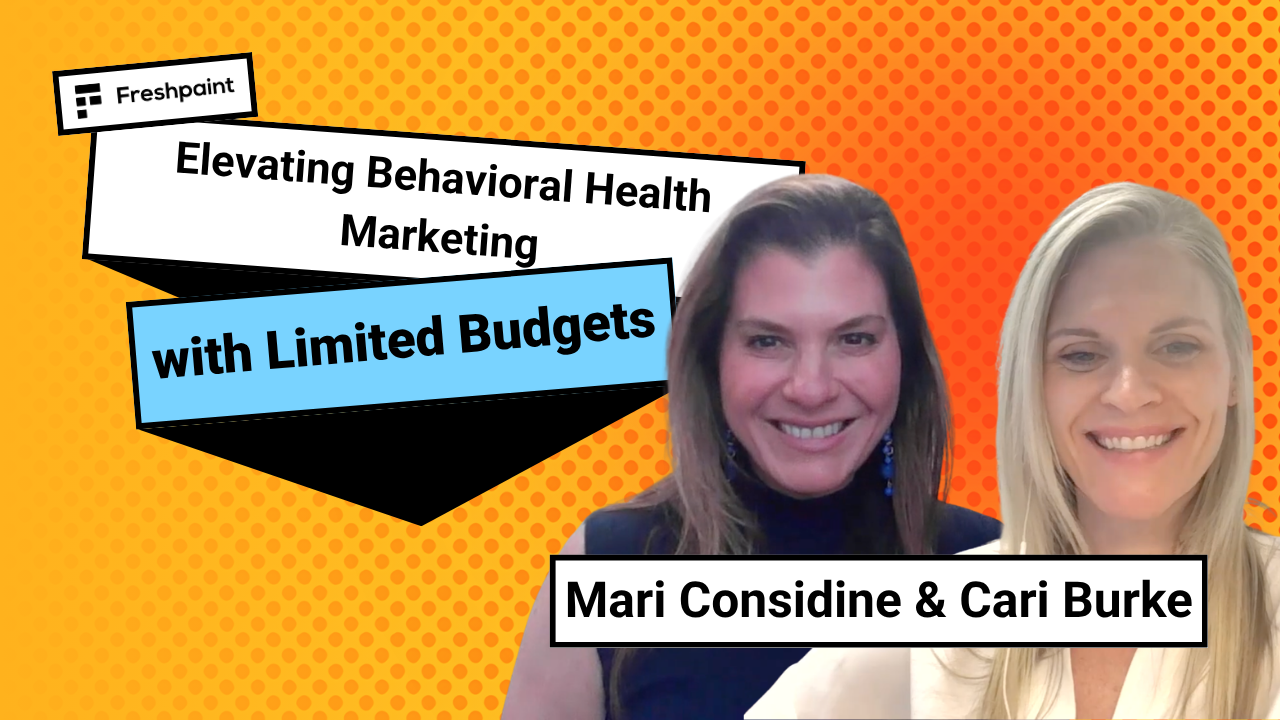
Elevating Behavioral Health Marketing with Limited Budgets with Mari Considine & Cari Burke

About Marketing Rounds
Marketing Rounds is a Freshpaint podcast about how healthcare marketers drive growth without breaking measurement—or compliance. Hosted by CEO Ray Mina, the series features operators who've moved beyond last-click thinking, built multi-channel strategies, earned executive buy-in, and figured out how to measure what actually matters. If you're working to reduce Google dependence, prove impact across channels, and protect patient privacy, start here—and subscribe to follow new episodes weekly.
There's a moment most healthcare marketing leaders recognize. You open your paid search dashboard and the CPCs look wrong — not slightly off, but dramatically higher. The market just changed, and somewhere behind that shift is a competitor with a war chest you can't match.
That's what happened to Acenda Integrated Health when PE-backed behavioral health organizations flooded the market post-COVID. Mari Considine, Chief Marketing and Communications Officer, and Cari Burke, AVP of Brand Engagement, didn't respond by asking for more budget.
Their conversation with Freshpaint CEO and Marketing Rounds host Ray Mina explores how they rebuilt the marketing function from the inside out — restructuring how the team defines success, earns executive trust, and owns the patient experience end-to-end.
Watch/listen to the full conversation below, or keep reading for the strategic breakdown.
1. Being Outspent on Google Is a Signal — Not a Sentence
The most dangerous response to budget-asymmetric competition is accepting the frame the competition sets.
If they're winning on paid search, the instinct is to spend more on paid search. When that's not an option, a better question opens up: where can we win that they can't?
For Acenda, the answer started with content — but not the generic kind. Most behavioral health organizations publish about anxiety and stress. Acenda went narrower and more clinically specific. “It wasn't about talking about general things like anxiety and stress,” Mari explained. “It was really these more unique approaches and very unique things.” That content started getting shared.
The second advantage was structural: speed. A small, aligned team can move on trending content before a competitor's brief clears review. The budget deficit that's a liability in paid media becomes an edge in organic and earned channels.
What's striking is how deliberately Mari and Cari have extended this logic to the next wave of disruption.
On AI search: “Oh, finally this might be an area where we can actually compete.” On TikTok, they recognized that younger audiences looking for behavioral health information aren't on Google or even AI — they're peer-to-peer on platforms where a nimble, community-based organization can move faster than a national competitor with a 12-week content calendar.
What this means for you
- Start with competitive anatomy, not channel selection: Where does being community-based, independent, and fast give you a structural advantage a national competitor can't replicate?
- Speed-to-publish is a real advantage — if you use it: Identify 2–3 content moments per quarter where you can move in 48 hours while a competitor waits two weeks for approvals.
- Audit your AI search footprint now: Comprehensive FAQs, specific service-line content, and clinical depth are exactly what AI-generated answers surface — and terrain where well-resourced community organizations can close the gap fastest.
2. Vanity Metrics Are Any Metric Your Finance Team Can't Act On
Acenda spent years tracking real metrics — clicks, impressions, campaign performance — and presenting them in a language that landed on deaf ears. The shift that changed things wasn't better data. It was tying every KPI to the organization's strategic plan and business goals, not marketing's internal benchmarks.
The downstream effects were significant. Budget requests that would have been denied started getting approved. Initiatives that “would've fallen completely flat two years ago,” Mari said, got resourced and launched — including the Brand Experience Design Lab and a formal clinician thought leadership program.
The deeper implication: when you tie marketing KPIs to business outcomes, you change what you measure internally.
Cari's framing is direct — clicks and impressions that don't result in appointments are data “all for nothing.” That's a harder standard. It's also the one that makes marketing legible to every other function in the organization.
What this means for you
- Map every externally-reported KPI to your strategic plan: If a metric doesn't connect to an existing organizational priority, find the connection or stop reporting it to leadership.
- Audit your budget request language: Could a CFO read your last three requests and immediately understand what outcome they're being asked to fund?
- Surface the initiatives that would get greenlit if the business case were clearer: Not every good idea needs more budget. Sometimes it needs better translation.
3. The Patient Journey Doesn’t Belong to One Team, It’s a Group Effort
The Brand Experience Design Lab sounds like a marketing project. It isn't, and that distinction is everything.
Acenda assembled a group that includes clinicians, HR, facilities, IT, access center staff, and people from outpatient and urgent care programs. Their first major output was an anonymous brand experience gap survey. Four consensus priorities came back — identified independently, without coordination, across the entire cross-functional group. Not “here's what marketing thinks is broken.” Here's what the whole organization agrees needs fixing.
One of those priorities was the phone. Even with heavy digital investment, the data was clear: “The numbers tell us that that's still not how people are making most of their appointments.” In behavioral health, people want to call. And Acenda's phone system had friction points their own staff — not marketing — flagged. That kind of insight only surfaces when marketing stops owning the narrative and starts hosting the conversation.
The department's name change — from “marketing and communications” to “brand marketing and engagement” — reflects what this model requires. Brand isn't what you say in ads. It's what someone experiences from the parking lot through the phone call through the appointment.
What this means for you
- Don't launch a brand experience initiative from inside marketing: Frame it as an organizational initiative marketing is facilitating. The person who runs your access center should feel like a co-founder, not a participant.
- Run an anonymous gap survey before you build your roadmap: Acenda got four unanimous priorities without marketing having to advocate for any of them — a far more defensible foundation than any internal audit.
- Check whether your investment matches where patients actually convert: In behavioral health, phone likely outperforms web forms. Does your investment in the phone experience reflect that?
The Shift Healthcare Marketing Must Make Today
The through-line here isn't about content strategy or brand labs or TikTok. It's about the orientation of the marketing function itself.
Healthcare marketing has spent years trying to prove its value through the language of reach and engagement. The teams outcompeting larger, better-funded rivals have learned to make their metrics legible to the people who control resource allocation. When you tie KPIs to organizational strategy, you stop asking for budget and start participating in decisions about where it goes.
There's a version of marketing that survives by being operationally busy. And a version that wins by building the infrastructure — cross-functional relationships, business-aligned measurement, genuine ownership of the patient experience — that turns marketing from a cost center into a growth engine. The teams that figure out how to build that infrastructure without waiting for budget are the ones that will look back and realize the resource constraint was what made them rigorous.
Experience the full conversation where Mari and Cari describe the wall of 70 service-line brochures that once defined Acenda's marketing operation, why they finally crossed the line on TikTok, how they got clinicians to participate in content through a formal thought leadership program, and the very specific April Fools Day timing of their brand new website launch.