Turning a Compliance Crisis into a Marketing Advantage with Lauren Anderson

Here’s a hot take: The HHS guidance was the best thing that ever happened to healthcare marketing measurement. Not because it solved anything — but because it forced teams to confront a problem they'd been comfortable ignoring for years: they couldn't connect their campaigns to patients in the first place.
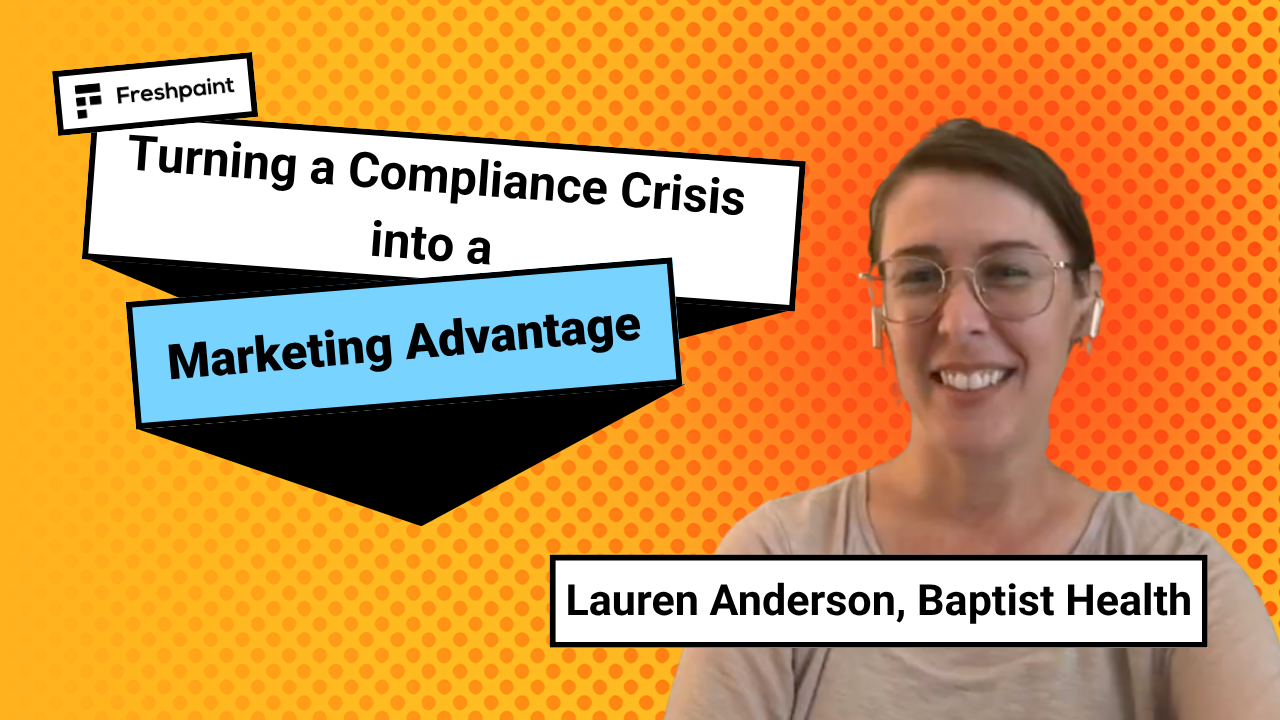
Lauren Anderson certainly agrees. Lauren is the Senior Digital Strategist and Copywriter at Baptist Health in Jacksonville — a regional system with six hospitals and 200+ specialty locations. She returned from maternity leave in January 2023 to a text from her chief consumer officer: take down all tracking and analytics ASAP.
When leadership continued to inquire about marketing performance, Lauren could have shrugged her shoulders but she didn’t. Instead, she drew them a diagram that explained how the compliance crisis was an opportunity for Baptist Health.
Her conversation with Freshpaint CEO and Marketing Rounds host Ray Mina is a step-by-step account of how that transformation happened — and what made it possible.
1. The HHS Guidance Didn't Create Your Data Problem — It Exposed One You Already Had
When leadership asked Lauren to strip out Baptist Health’s marketing tech stack, her first move was to draw a picture. Not a replacement plan — a map showing where attribution stopped working. Form fills that went nowhere. Call center handoffs with no feedback loop. Open scheduling in Epic that dropped UTM data the moment a patient left the site.
She took that diagram to leadership to show them what they were actually dealing with: a measurement architecture that had never been built properly in the first place.
“I felt like we were already kind of blind,” she said. “Because there was so much we didn't know.”
Lauren’s quick, creative thinking led Baptist Health to reframed the moment every healthcare marketer faced in 2022 from “we need a compliant marketing analytics solution” to “we need to rethink our entire data infrastructure.”
What this means for you
Organizations that treated HHS as a checkbox are still running on form-fill conversions. But organizations, like Baptist Health, that treated it as an audit now have visibility they never had before the guidance dropped. Wherever you are on that spectrum, it’s always a smart move to audit your data infrastructure.
- Draw the gaps diagram first: Map every point in the patient journey where attribution either transfers between systems or disappears — before evaluating any new tool.
- Identify your real conversion actions: Which events in your stack represent actual patient intent, and which are just what was easiest to track?
- Use the compliance audit as the business case: If your team hasn't had the attribution conversation with leadership, the compliance mandate is the opening.
2. Attribution Is a Cross-Functional Infrastructure Problem, Not a Marketing Fix
Lauren is clear on this: she could not have built the Baptist Health stack alone. It required IS, legal and risk, Epic, Invoca, and Salesforce expertise — all coordinating around a shared problem none of them could solve in isolation.
What made it work was a standing monthly meeting where each function shared its expertise. Information Systems (IS) didn't know a third-party video player embedded on the site was passing tracking data. Marketing didn't know all the state-level legal distinctions. Legal didn't understand the full implications of removing call tracking. The only path forward was deliberate collaboration — and a collective decision about what level of compliance rigor made sense for Baptist Health's size and budget, rather than chasing an unachievable standard of perfection.
The result: UTM parameters now pass through Epic's scheduling widget into Snowflake, connecting campaign source to appointments and show rates. All of it surfaces in a single dashboard that answers leadership's questions automatically, without Lauren spending a week pulling spreadsheets.
What this means for you
- Get IS or the equivalent in the room before you evaluate vendors: Healthcare attribution is a data architecture decision. Security review will kill momentum if IS is surprised by the implementation.
- Bring legal in at the design stage, not the approval stage: The compliance conversation changes what's technically possible. Organizations that loop legal in early build stacks that work.
- Define your risk posture as a group: Decide what level of compliance rigor is appropriate for your organization's size and budget — then instrument to that standard.
3. Google Doesn’t Know Form Fills Aren’t Patients — But You Do
For years, Baptist Health sent Google a form fill as its primary conversion signal. That told Google: get me more form fillers. It had no way to know which of those form fillers ever became patients. Lauren describes it as training a golden retriever. “You have to explain: this is what a good job looks like. This is what I want you to retrieve for me.”
When Baptist Health ran a head-to-head comparison between two paid search vendors — one running optimized appointment-level conversion signals, one using traditional metrics — the gap was stark. The vendor with better signals delivered leads at roughly $28 each. The other delivered leads at $70 to $80 each. Same market, same service lines. The difference was entirely in what Google was told to optimize against.
Baptist Health is now moving toward sending appointment-booked and attended signals through Invoca's AI classification rather than call duration, turning their attribution stack into their optimization engine.
What this means for you
- Audit your current conversion actions: What behavior are you actually telling Google to maximize? If it's a form fill or a one-minute call, you're optimizing for a proxy, not an outcome.
- Move your signals downstream one step at a time: You don't need the full stack on day one. Start by connecting call intent data to campaign source, then layer in scheduling data as the infrastructure matures.
- Use conversion quality to evaluate vendors: Cost per lead means nothing without knowing what kind of lead. Run head-to-head comparisons on cost per qualified conversion, not volume.
The Shift Healthcare Marketing Must Make Today
Three years after Lauren saw an opportunity in the HHS guidance, campaign data flows automatically from Google Ads through Epic's open scheduling, Invoca call tracking, and Snowflake into a Salesforce dashboard connecting spend to actual attended appointments — and Baptist Health's cost per lead has dropped by roughly 60%.
Experience the full conversation where Lauren talks about returning from maternity leave to find ChatGPT had launched while she was gone, why she started dreaming about UTM campaigns, how she's preparing Baptist Health for the agentic web, and the moment a vendor's search term report showed they'd been running hernia ads against hip hop artist lyrics.


.png)

.png)