The Myopia Bet: Inside the Stellest Launch with Matthew Jackson
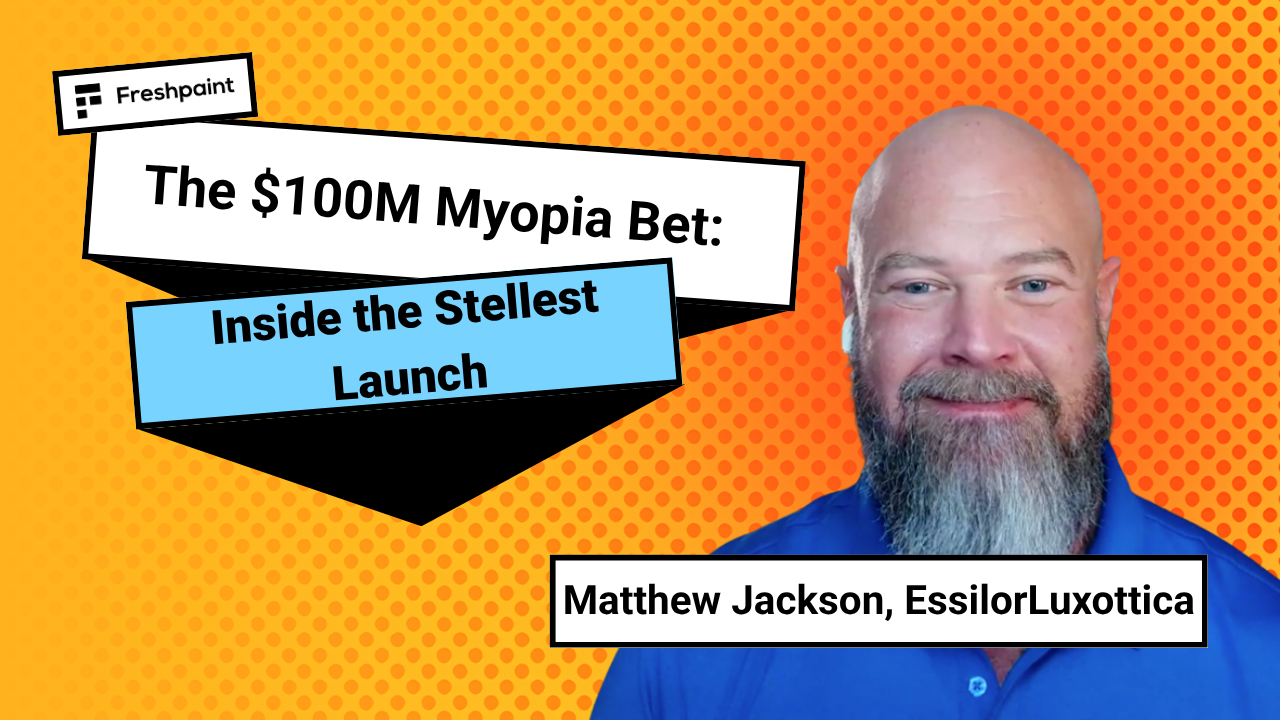

Two of marketing's hardest problems rarely show up at the same time: creating demand for a category your audience doesn't know to look for, and proving impact when the conversion happens somewhere you can't see. Healthcare runs into each one often. Stitching them together — on a deadline, with first-mover pressure — is rarer.
That's the launch Matt Jackson is running right now. As Director of Americas, Consumer Media and Digital at EssilorLuxottica, Matt sits inside what he calls "one of the biggest companies you've never heard of" — the eyewear giant most consumers know only through its retail brands (LensCrafters, Pearle Vision, Sunglass Hut) and licensed names (Ray-Ban, Oakley, Versace). He works on the medical side of the business, and his current focus is Stellest: the first and only spectacle lens FDA-authorized in the U.S. to slow the progression of myopia in children. It became available in late 2025.
His conversation with Freshpaint CEO and Marketing Rounds host Ray Mina is a study in sequencing, proxy measurement, and the maturation of “awareness” channels into conversion channels.
1. Distribution Readiness Has to Lead Consumer Activation
When a product launches with a first-mover window, the instinct is to activate consumer demand immediately. For categories distributed through partners the brand doesn't own, that instinct is dangerous. A first interaction with an unfamiliar pediatric category is the wrong place to fail.
Stellest is distributed through thousands of independent eye care practices — EssilorLuxottica's customers, not its owned locations. Before a single consumer dollar went into market, Matt's team spent months getting myopia practice protocols in place, building the technical setup to route Stellest orders to processing labs, and training providers on the product itself.
“If we actually activate a consumer who's totally interested and ready to go, and they enter a door that doesn't have the product, it's not ideal,” Matt said. Even after launch, consumer activation was geographically gated to markets with both early-adopting practices and overlapping patient demographics.
The discipline isn't about spending less — it's recognizing that for category-creating launches in fragmented distribution, demand and supply have to advance in lockstep.
What this means for you
- Audit distribution readiness market by market, not nationally: A national launch is meaningless if providers a patient will reach can't fulfill the order or explain the product credibly.
- Phase consumer media to follow distribution coverage, not the calendar: The fastest path to permanent damage is activating demand into pockets where the experience will fail.
- Build a B2B education layer before any consumer story runs: The provider in the exam room closes the conversion. If they don't know the product, the campaign was a leak.
2. When Attribution Stops at the Door, Visit Lift Becomes the Conversion Event
The classical D2C playbook lets you draw a line from impression to cart to purchase. Most of healthcare can't. Matt's situation is the extreme case: he drives traffic to essilor.com, where parents use a store locator and click a “book now” button — which takes them off-site to whatever booking platform a given practice uses. Past that click, Matt is blind.
What he can see: visit lift.
By partnering with foot traffic measurement panels, his team correlates media exposure to incremental visits at participating practices. Visit lift becomes a credible conversion event in its own right because the product can't be acquired any other way: “You're not gonna be able to get this product if you don't go to the eye doctor.” Early signals are landing in the upper single digits to double digits.
The decision cycle is long — roughly 30 days for a parent to act after media exposure, plus another 30 days for sales data to clear lab routing and fulfillment. The model has to work on a 60-day horizon, and leadership expectations have to be calibrated to it.
What this means for you
- Identify the closest action to conversion that you can see: For Matt, it's the practice visit. For a hospital marketer, it might be appointment booking. That's your conversion event — not the impression, not the click.
- Pair every proxy with a correlation model to actual revenue: Proxy metrics persuade leadership only when the link to the bottom of the funnel is explicit.
- Reset measurement windows to match decision cycles: Demanding 30-day ROI on a 90-day decision is how good campaigns get killed prematurely.
3. Connected TV and Digital Audio Aren't Awareness Channels Anymore
For most of the last decade, the healthcare channel taxonomy has been clean: search captures intent, social drives consideration, and TV, radio, CTV, and audio handle awareness. That taxonomy is increasingly obsolete — and for category-creating launches, leaning on it is a mistake.
Connected TV and digital audio have evolved from impression engines into action-oriented channels with conversion-aware audience tools, contextual targeting, and pixel-driven feedback loops that didn't exist five years ago. Matt's team uses them not to flood the market with impressions but to reach smaller, sharper audiences with creative built for measurable response. The signal shows up in foot traffic, qualified web sessions, and locator engagement.
“Just throwing out commercials is not the answer anymore,” Matt said. Channels formerly called “upper funnel” can now do conversion work, and treating them as awareness-only leaves their best new capability on the table.
The next frontier Matt is sizing up is creator and influencer media — where the open question is whether the measurement loop can close the way it has for CTV and audio.
What this means for you
- Re-classify your channel mix by what each one can now measure, not what it could measure five years ago: CTV and digital audio belong on the conversion side of your media plan when they're built that way.
- Choose smaller, more qualified audiences over broad reach when the goal is action: Reach is a metric for awareness budgets. Conversion campaigns earn their keep on quality.
- Apply the same measurement discipline to creator work: If you can't tie a creator program to visit lift, qualified traffic, or downstream action, you have a brand experiment, not a channel.
The Shift Healthcare Marketing Must Make Today
The through-line across Matt's playbook isn't really about Stellest, pediatric myopia, or independent practices. It's about what happens when the standard healthcare marketing assumptions — the audience knows what to search for, the brand owns the conversion path, the channels divide neatly into funnel stages — all break at once.
When your audience doesn't know to search, you build the category. When you don't own the conversion, you instrument the next-closest event and earn leadership's trust in it. When the channels you used to call “awareness” can drive measurable action, you stop treating their old labels as fixed. The marketers who keep optimizing within yesterday's taxonomy will keep producing media plans that look great on paper and underperform against business goals. The ones rebuilding the operating model will own the next category before the rest of the market notices it exists.
Experience the full conversation where Matt explains why pediatric myopia is surging in the first place, how school nurses and pediatricians have become an unlikely first-detection layer, and why he's openly jealous of marketers who can wire a celebrity post directly to a pair of sneakers.


.png)