The Marketing Measurement Gap That’s Costing Direct-to-Patient Pharma Billions
.jpg)



The 10 largest pharmaceutical companies alone spent nearly $14 billion on advertising and promotion in the U.S. in 2023, much of it directed toward consumer-facing marketing efforts. And despite the investments in direct-to-patient (DTP) creative campaigns, pharma marketing admit they often cannot assess whether those investments lead to completed appointments, prescription fills, or continued therapeutic usage.
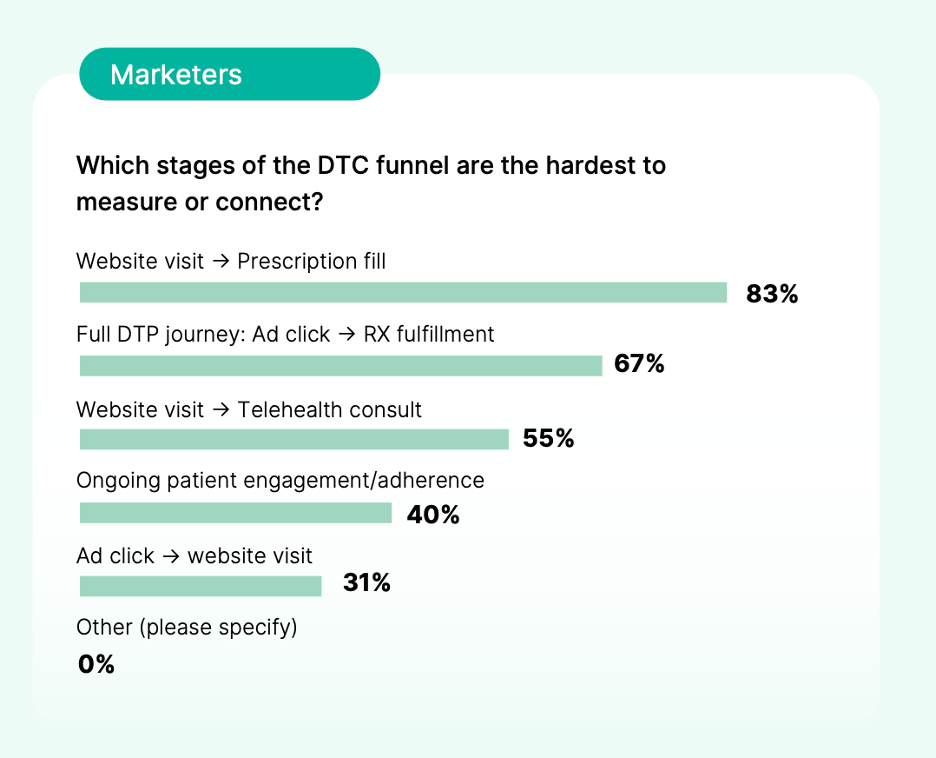
New DigiPharma Insights and Freshpaint research shows that 83% of DTP pharma marketers struggle to connect marketing activity to prescription fills, severely limiting their understanding of how their campaigns influence revenue.
In our recent piece on the legal action that a top pharma company faces over patient data potentially shared with third-party tracking tools, we discussed how disconnected patient tracking increases legal exposure. In this article, we’ll explain why DTP pharma marketing has to be approached differently than ecommerce, and walk through a six-step roadmap to unlock richer reporting, better decision-making, and higher ROI for DTP campaigns.
Why the Ecommerce Playbook Doesn't Fully Translate to Pharma
The rise of direct-to-patient pharma brands like PfizerForAll, AZDirect, and LillyDirect has transformed the way patients access therapeutics — and the way pharmaceutical companies promote them. Patients can order a treatment in just a few clicks, and DTP pharma marketers are thinking more like their marketing peers in DTC and ecommerce, leveraging creative social, CTV, and programmatic media to captivate patients’ attention and direct them to owned properties like apps and websites.
As more pharmaceutical companies adopt DTP models and partner-based fulfillment networks, though, the number of cross-domain handoffs in the patient journey continues to increase, exacerbating measurement. And while their tactics may resemble ecommerce, DTP pharma marketers have a unique blind spot: The moment a patient crosses from their branded site to the telehealth or specialty-pharmacy partner to get a consult virtually or make a purchase, marketing’s visibility into patient actions disappears.
Challenge: Connecting Fragmented, Cross-Domain Buying Behavior to Marketing Campaigns
Unlike traditional pharma brand marketing, DTP programs are expected to drive measurable patient acquisition. Marketing teams are increasingly held accountable for patient starts, prescription fills, and retention, not just awareness or physician engagement.
Yet, today’s direct-to-patient pharma buying journey spans multiple complex domains, with the pharma brand often blind to the purchase moment. For example:
- A patient may first encounter a brand through a meta ad or paid search.
- They then proceed to a website or social channel to learn more.
- When they’re ready to purchase, they’re directed to a telehealth partner for a consultation, followed by an online pharmacy to fill the prescription — partners beyond a pharma brand’s direct control.
To measure marketing performance and optimize campaigns, attribution data needs to survive those cross-domain handoffs.
But there’s another layer DTP marketers have to understand: the lack of data infrastructure to compliantly track digital behavior and intent. You can drop a pixel on your branded drug site, but you can't follow a patient into a specialty pharmacy portal or telehealth flow, because those are third-party domains. What that means in practice: the moment a patient leaves your site to complete their prescription, pharma marketers lose visibility. They don't know if they filled it. They don't know which ad drove them there. And the platform keeps optimizing on the last signal it got — a click.
Unsurprisingly, the data suggests measurement challenges are widespread across DTP pharma organizations. Our research found that:
- Just 1% of marketers report having a fully integrated, privacy-compliant patient data ecosystem.
- 55% of DTP pharma marketers can’t connect website visits to telehealth consultations.
- 62% of privacy leaders have only partial visibility into how data flows through pixels and analytics tools.
The fragmentation problem is likely to compound, as more consumers shift toward virtual care for refills and prescription drug purchases from online pharmacies grow exponentially.
The Risks of Measuring Activity Instead of Outcomes
In lieu of bottom-of-funnel conversion data, many DTP pharma marketers are reporting performance with the top-of-funnel metrics that they can access, like impressions and clicks. As one DTP pharma marketer describes, "at this point we are still overly dependent on proxy metrics like clicks and form fills rather than true patient outcomes."
Relying exclusively on proxy metrics can ultimately limit patient acquisition, trust, and future resources. Downstream impacts include:
- Ad platforms are trained to drive clicks, not revenue.
Ad platforms, like Meta and Google, are optimization machines. But they’re only as smart as the signals you feed them. When you send clicks and impressions back to ad platforms as conversion metrics, the platforms will optimize your campaigns to find more clickers, as opposed to patients who are ready to fill a prescription.
It’s also important for DTP marketers to note: while advertising platforms like Google and Meta offer pixels to connect ad impressions to website visits, pharma teams cannot drop pixels on third-party platforms like telehealth platforms and specialty pharmacies in the same way. With the regulatory landscape constantly evolving, DTP pharma marketers need to be cognizant of how sensitive health information is being collected, stored, and shared with third-party systems.
- Without visibility into downstream patient behaviors, budget decisions are often based on incomplete information. Channels that appear efficient at driving clicks may not be the channels driving therapeutic starts or prescription fills. As a result, marketers cannot easily ascertain which campaigns, channels, and audiences are driving patient behavior, revenue, or outcomes.
Over time, the lack of outcome-level data makes forecasting, media planning, and patient acquisition modeling increasingly difficult.
- Without accurate revenue reporting, marketing cannot easily defend its resourcing.
CEOs and CFOs think in dollars, not clicks. As top-of-funnel metrics represent activity and not revenue, marketing has an uphill battle requesting more budget without a clear tie to revenue impact.
As another marketing leader put it, "once a patient leaves our digital ecosystem and enters the insurance approval process, the journey becomes very uncertain.”
How to Achieve Full-Funnel DTP Measurement in Pharma Marketing: A Step-By-Step Guide
High-performing DTP pharma teams are rethinking their approach. Instead of managing dozens of independent trackers and downstream fixes, they’re implementing a centralized data foundation that maintains continuity across domains.
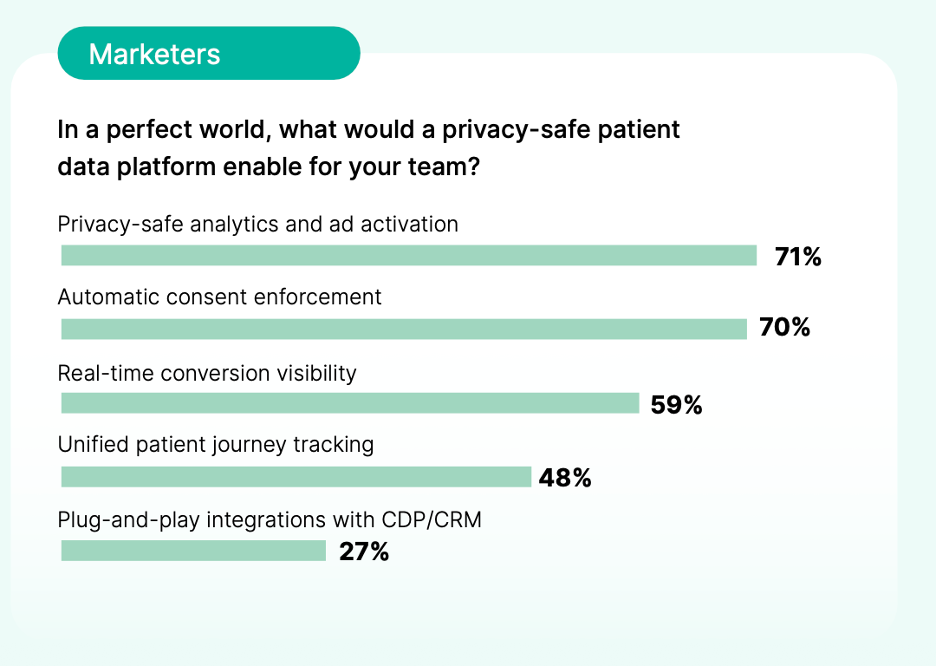
With the entire patient journey unified in a single, governed system, teams are moving beyond proxy metrics and connecting marketing investments to bottom-funnel outcomes, like patient starts, prescription fills, and adherence over time.
Let’s walk through a six-step process for laying that foundation for your organization.
- Identify where your funnel is breaking.
Begin by mapping your patient journey and finding where your visibility disappears. Audit each cross-domain step from website/app, to telehealth provider, to pharmacy checkout, and see where the data trail stops. Most teams find 1-2 handoff points where they lose visibility. - Get your legal structure in place.
DTP pharma programs touch sensitive health data across multiple systems and partners, and the right data agreements depend on how your go-to-market is structured, not a one-size-fits-all framework. Data Processing Agreements (DPAs) are typically required when third-party systems — analytics tools, ad platforms, data platforms — are collecting and managing data from your websites and apps. If your program routes patients through a third-party fulfillment partner like a telehealth provider or specialty pharmacy, additional data agreements with those partners may be necessary to govern how conversion signals are collected, de-identified, and passed back to you and your ad platforms. Talk to your legal team early to map your data flows and understand where agreements are needed and with whom. - Instrument compliant cross-domain pipelines.
Placing standard third-party pixels on partner sites creates privacy and legal exposure. Instead, implement a governed data pipeline that allows telehealth and pharmacy partners to share conversion events in a privacy-conscious way. Sensitive health information is removed before the data is transmitted, and only de-identified conversion signals are sent back to the brand and advertising platforms. This preserves the connection between marketing activity and patient outcomes without exposing PHI. - Feed compliant conversion signals back to ad platforms.
With compliant conversion tracking in place, you can send bottom-of-funnel events, like completed appointments and prescription fills, back to ad platforms as offline or server-side conversion events. This trains platform algorithms to optimize for revenue outcomes instead of activity metrics. - Recalculate acquisition costs.
Rebuild your CAC model using completed patient starts as the denominator instead of estimated conversion rates applied to click data. - Build full-funnel reporting.
Create a unified dashboard that connects ad spend, website/app visits, telehealth appointments, and prescription fills. End-to-end reporting provides leadership with an auditable view of marketing’s impact on patient outcomes — and sets marketing up to earn additional budget and resources.
Connect Every Campaign to a Patient Outcome
As DTP pharma marketing strategies become a greater component of pharma marketing, marketers’ ability to assess and defend the revenue impact of their investments will be critical.
By adopting a solution like Freshpaint for full-funnel measurement, teams gain:
- Clearer visibility into the marketing actions that drive patient outcomes
- Centralized, consented data with full control over how it’s shared and activated
- Better campaign performance on ad platforms like Meta and Google
- Greater confidence across marketing, compliance, and leadership








.png)