Overcoming IT Hurdles to Enhance Marketing Performance with Clint Paul


About Marketing Rounds
Marketing Rounds is a Freshpaint podcast about how healthcare marketers drive growth without breaking measurement—or compliance. Hosted by CEO Ray Mina, the series features operators who've moved beyond last-click thinking, built multi-channel strategies, earned executive buy-in, and figured out how to measure what actually matters. If you're working to reduce Google dependence, prove impact across channels, and protect patient privacy, start here—and subscribe to follow new episodes weekly.
At some point in the last few years, a healthcare marketing team connected their ad spend to downstream patient data for the first time.
What they found: their actual cost per acquisition was twice what they'd been reporting to leadership. Not because anything had changed. Because they'd finally looked.
That's not a technology story. It's a measurement story — and it's more common than the industry admits.
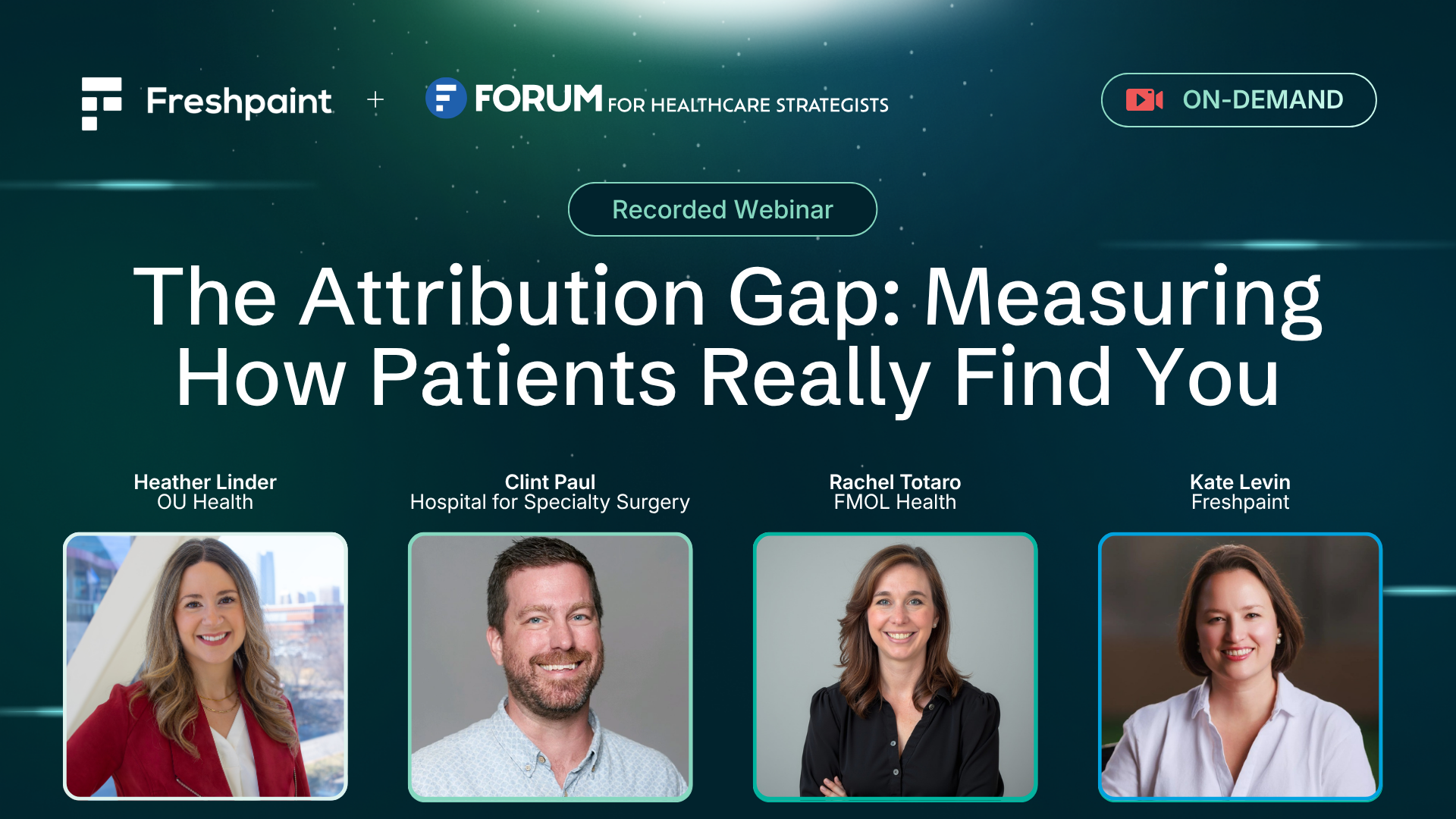
Clint Paul, Director of Marketing Analytics at Hospital for Special Surgery, spent three years closing that gap. It started in 2022, when an HHS compliance crisis forced HSS to strip most of their tracking infrastructure and rebuild from scratch. As the number-one ranked orthopedics hospital in the country — operating without the referral pipeline of an integrated health system, in a city with no shortage of competing orthopedic programs — measurement at HSS isn't a reporting exercise. It's how patients find them at all.
His conversation with Freshpaint CEO and Marketing Rounds host Ray Mina breaks down how he built the connection from web analytics to confirmed appointments in Epic — and what changed inside the organization once he had the data to show for it.
Watch/listen to the full conversation below, or keep reading for the strategic breakdown.
1. The Compliance Reset Was an Invitation to Stop Measuring the Wrong Things
Before 2022, HSS had been measuring what was easy to measure: clicks, click-through rates, cost per click. The attribution stack was built around what the tools surfaced by default, not around what the organization needed to know. “Knowing what we know now,” Clint said, “those things are so inefficient for any sort of correlation to appointments or anything like that.”
Going dark forced a different kind of intentionality. Rather than simply restoring what existed before, HSS had to make deliberate choices about what to rebuild and why. The first step was establishing a BAA agreement with a HIPAA-compliant analytics platform to recover directional visibility. But the reset also forced a more fundamental question: what does HSS actually need to measure to make defensible decisions?
The answer wasn't sessions or form fills. It was booked appointments. That became the north star for everything Clint built over the following three years — a measurement infrastructure oriented around outcomes, not activity. The compliance crisis didn't just force compliance. It forced clarity.
What this means for you
- Audit what you're defending, not just what you're tracking: If the metrics in your quarterly report don't connect to a patient outcome finance recognizes, you're building a case for something nobody asked for. Start with attended appointments or new patients acquired and work backward to which data tells that story.
- A compliance reset is a measurement reset: Resist the impulse to restore what you had. What did the old setup fail to answer? Build toward that instead.
2. The Assumptions That Collapse When You See Past the Booking Form
Getting back to baseline was the first task. The real unlock was what came after.
Clint had always known there was a drop-off point. Web analytics could track behavior up to a threshold — a physician page, a booking form submission — and then the journey moved into Epic and visibility disappeared. The assumptions started there and compounded downstream.
The call tracking story made this concrete. Before 2022, HSS had been counting any call over two minutes as a conversion. When Clint started listening to those calls himself, the assumption collapsed. “I was like, guys, like we way overestimated what's going on for two minutes on one of these calls.” A two-minute call isn't a conversion — it's a conversation. If that's your signal, you're optimizing your campaigns toward conversations.
The same gap existed at every stage: appointment bookings that canceled, form fills that never converted, campaigns that looked efficient in the ad platform but were generating meaningful falloff before anyone walked through the door. If you're reporting that a campaign drove 400 bookings and finance doesn't know a significant percentage never materialized, you're not telling a false story. You're telling an incomplete one.
The connection Clint built runs from the web analytics data lake into Epic appointment records, matched on fields that tie a session to a confirmed booking with sufficient confidence. The output — presented at Freshpaint's House Call event in New Orleans — was a visualization of confirmed, booked appointment volume by channel over time. Not form fills, not sessions. Actual booked appointments, attributed to the channels that drove them. When leadership saw it: “Oh, now we understand what you've been saying.”
What this means for you
- Pressure-test what you're calling a conversion: If your conversion events are time-threshold calls or form fills, ask: what percentage of those actually result in an attended appointment? If you don't know, you don't know what you're optimizing toward.
- The gap between assumed and actual CAC is almost always larger than expected: Teams who've connected data end-to-end consistently find their real cost per acquisition is meaningfully higher than proxy metrics suggested. The sooner you know, the sooner you can fix it.
3. The Hardest Part of Connecting Marketing to Epic Isn't Technical
Everything above required one thing Clint couldn't build himself: the cooperation of the Epic IT team.
Every department in the organization is asking that team for something, and most of those requests are more directly tied to clinical operations than a marketing attribution project. Arrive unprepared, and you won't get a no — you'll get a deferral, and then another, and eventually the project dies.
Clint's approach was deliberate. Rather than arriving with an exploratory ask — “we have this idea, what do you think?” — he came with a complete request: the specific data fields he believed could be matched, the logic of the connection, the steps he thought were required. “The main thing,” he said, “is to know enough about what needs to get done to save them the trouble of coming up with an answer themselves.”
The same principle applied to legal: rather than bringing speculative ideas that would get shot down, he self-filtered aggressively so that when he did bring a request, it arrived pre-vetted. Marketing's credibility as an internal partner was itself an asset worth protecting.
That credibility is what made the leadership conversation land. The appointment attribution chart worked because the data behind it was trusted — not a model, not a projection, but a definition everyone had agreed on. “I don't want to tell people fake numbers that are gonna be meaningless. I want alignment over everything.” That shared definition is what lets marketing and finance finally speak the same language: real outcomes, in terms the whole business can get behind.
What this means for you
- Come to IT with a complete ask, not an exploratory one: Identify the specific fields you believe can be matched, the matching logic, and the outcome you're trying to produce. Make it easy to say yes to a concrete plan.
- Define your metrics jointly: The appointment attribution data that changed Clint's leadership conversations worked because the definitions were shared. Build toward measurement finance already trusts, not just measurement marketing prefers.
The Shift Healthcare Marketing Must Make Today
The throughline in Clint's story isn't really about Epic integrations or data lakes. It's about accountability — the decision to stop accepting the gap between what marketing reports and what actually happened.
That gap has always been closable. What it required was treating measurement as a cross-functional project, not a marketing project: building the IT relationships, doing the organizational work, and earning the internal credibility to make the data trustworthy once it arrived.
The marketing teams that make that investment are the ones that will be able to defend their budgets, expand their mandates, and build the kind of trust with finance that unlocks real investment. The teams that don't will keep defending activity — until leadership stops accepting that as an answer.
Experience the full conversation where Clint talks about the three jobs HSS has to do in a single 30-second ad that most health systems never have to think about and the first thing he'd do tomorrow if he were starting this project from scratch.




.png)