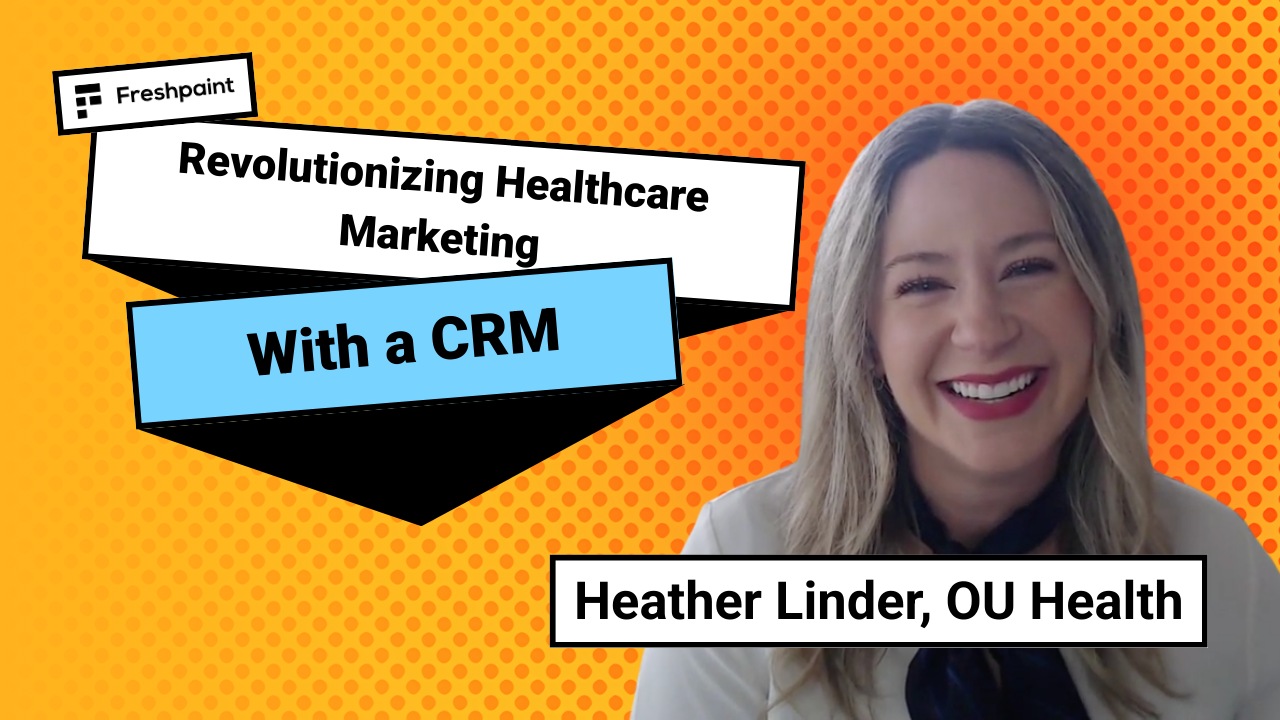
Revolutionizing Healthcare Marketing with a CRM with Heather Linder

Most healthcare marketing strategies are built around the same assumption: growth comes from acquiring new patients. Fill the top of the funnel. Drive volume. Repeat.
Heather Linder doesn't have that luxury—and it's made her a sharper marketer for it.
As VP of Brand and Growth Marketing at OU Health, Oklahoma's only academic health system, Heather operates in a fundamentally different environment than most healthcare marketers.
She can't grow by buying up regional systems or expanding into new markets. The population is fixed, the geography is vast and rural, and the organization is still rebuilding trust after years of operating under a disconnected for-profit model. Growth, for OU Health, means getting smarter about the patients they already have access to—and building the data infrastructure to find, engage, and re-engage them with precision.
Her conversation with Freshpaint CEO and Marketing Rounds host Ray Mina is a practitioner's guide to what that actually looks like: CRM as an orchestration engine, first-party data tied to clinical outcomes, and a measurement philosophy built to survive the CFO scrutiny that's coming for every health system's marketing budget.
1. The Most Untapped Growth Lever in Healthcare Isn't New Patients
When Heather joined OU Health, she made a bet that most marketing leaders don't make: she invested in a CRM before scaling acquisition spend.
The reasoning was straightforward, even if the execution wasn't. OU Health isn't trying to be a health system for everything. It's positioning itself as the destination for complex and specialized care in a state where it trains nearly 80% of physicians—and where it's the only system that can offer certain subspecialties at all. That's a referral-driven, relationship-dependent growth model. And it doesn't run on impressions.
Heather's team started with a simple but powerful use case: women over 40 in OU Health's EMR who had never scheduled a mammogram. These patients already trusted the system. They just hadn't been nudged—or had been nudged through the wrong channel at the wrong time.
“We were able to build a significant volume of business from people who already trust us,” Heather said. “They're already in our EMR, they could easily schedule—really low barrier, low cost.”
The re-engagement opportunity is one most healthcare marketing teams chronically underweight. Lapsed patients or people already in your system—already predisposed to choose you—generate meaningful volume at a fraction of the acquisition cost, with a trust baseline that no new patient campaign can manufacture.
For OU Health, that first phase of precision patient marketing became the proof of concept that justified the broader CRM investment. Once leadership saw what was possible from unpaid outreach to their own patients, the conversation about what they could do with full first-party data infrastructure shifted considerably.
What this means for you
Before scaling acquisition spend, audit what you already have:
- Lapsed patients by service line: Who's in your EMR that hasn't been back in 12–24 months? Which of those patients are age- or condition-eligible for a service they haven't scheduled?
- Screening gaps: Where do you have populations who qualify for a preventive service but haven't completed it? These are low-barrier, high-trust touchpoints.
- Low-cost re-engagement channels: Email and in-system messaging to existing patients typically costs a fraction of paid acquisition—and converts at higher rates because the trust baseline is already there.
The argument isn't that new patient acquisition doesn't matter. It's that re-engagement is chronically underfunded relative to its opportunity, and in a market where you can't simply expand your way to growth, it deserves to come first.
2. Precision Only Works If You Know Which Channel the Patient Trusts
Oklahoma ranks near the bottom nationally in cancer screenings and outcomes—too many patients were presenting with late-stage diagnoses because they'd never been prompted to screen when it would have mattered.
With the CRM connected to the EMR, Heather's team realized they could change that.
They used propensity modeling and claims data to identify high-risk patients, built segmented multi-touch journeys to nudge them toward screening, and coordinated the digital outreach with OU Health's mobile screening units — state-of-the-art CT scanners on a bus, driving directly to rural communities and employer parking lots. Community partnerships and tribal health networks became distribution channels.
What made this work wasn't just the targeting—it was delivering the message through a channel patients already associated with their care. A scheduling prompt via MyChart reads as a recommendation from a care team. The same message in a marketing email reads as a company knowing things it maybe shouldn't.
“The trust is the glass jar of marbles,” Heather said. “It takes so many marbles you put in over time of building that up, and you send one wrong email or something that's mistargeted, and you just shatter the whole thing.”
Channel selection in healthcare isn't just a reach or efficiency question — it's a trust question. The data layer determines who gets the message. The channel layer determines whether it lands.
What this means for you
Build your patient journey orchestration around two parallel questions—not one:
- Who should receive this message? (Segmentation: diagnosis, risk score, demographics, service line eligibility)
- Where does this message belong? (Channel: MyChart for clinical nudges from care teams, marketing email or SMS for consumer-facing outreach, programmatic for net-new awareness)
The data layer determines the who. The channel layer determines whether the message lands with trust or triggers discomfort. Getting the first right while ignoring the second is one of the most common—and most expensive—mistakes healthcare marketers make with personalization.
3. Proving Marketing Value Means Linking Campaigns to Downstream Revenue—Not Just Awareness
Healthcare marketing budgets are already under pressure—and in a state watching federal Medicaid reimbursement changes with real anxiety, Heather isn't waiting for the conversation to come to her.
“We're all kind of operating on borrowed time,” she said. Marketing is almost always the first place cuts start, and most teams aren't positioned to defend themselves because they're reporting on metrics leadership doesn't find credible.
Heather's answer is to connect campaign-level data directly to downstream appointments and attributed revenue—tracing a tactic through to a scheduled visit, an attended appointment, and a billed encounter.
“To sit down with your financial leaders and say, look, you gave us a million dollars to build marketing campaigns, and we brought you more than that.” That requires the CRM to be connected to the EMR, and attribution built into every campaign from the start—unique phone numbers, UTM parameters, dedicated landing pages. No mechanism means no credit.
The payoff is twofold:
- Marketing becomes a revenue-generating function with a defensible number
- The team gains the internal clarity to optimize in real time rather than discovering at a six-month wrap that spend was misallocated
But the data is only half the job. “Marketers are really good at telling stories externally,” Heather observed, “but not internally.” Translating campaign proof into language that lands with finance and clinical leadership is its own discipline — and in the budget environment coming for most health systems, it's not optional.
What this means for you
Audit your current measurement stack against this standard: can you connect a specific campaign tactic to a downstream attended appointment and attributed revenue?
If the answer is no—or only partially—that's the infrastructure gap to close before the next budget cycle. The specific questions to answer:
- Is your CRM connected to your EMR? Without this link, campaign-level performance data stops at the conversion event (form fill, call) and never reaches the clinical outcome.
- Is every campaign tactic instrumented? Every channel needs a tracking mechanism that survives handoff to the call center, scheduling system, and clinical workflow. No mechanism means no attribution—and no credit.
- Are you building the internal narrative alongside the external one? The people who control your budget aren't sitting in marketing meetings. They need a simplified, financially-framed version of what your campaigns are producing—and they need to hear it more often than you think.
The organizations that will weather the next round of healthcare budget pressure aren't the ones with the most creative campaigns. They're the ones that can walk into a room with the CFO and show exactly what marketing returned on every dollar spent.
The Shift Healthcare Marketing Must Make Today
What Heather has built at OU Health isn't a media strategy. It's a data infrastructure that makes every marketing decision more precise—which patients to reach, through which channel, with which message, at which moment in their care journey—and every dollar more defensible to the people holding the purse strings.
The fixed-market constraint that makes her job harder in some ways has made her clearer about what actually drives growth: not more spend, but smarter orchestration of the patients and relationships you already have. Re-engagement before acquisition. Channel trust before personalization. Revenue attribution before budget defense.
These aren't principles limited to health systems without room to expand. They're the fundamentals that every healthcare marketing team needs to build—before the next round of cuts forces the conversation.
Experience the full conversation where Heather discusses how OU Health approaches brand investment in a market where most people don't understand what academic healthcare means, why the chief family health officer dynamic shapes her campaign creative, how OU Health uses its partnership with the OKC Thunder to create community presence, and what the path from propensity scoring to preventive screening actually looks like in practice.