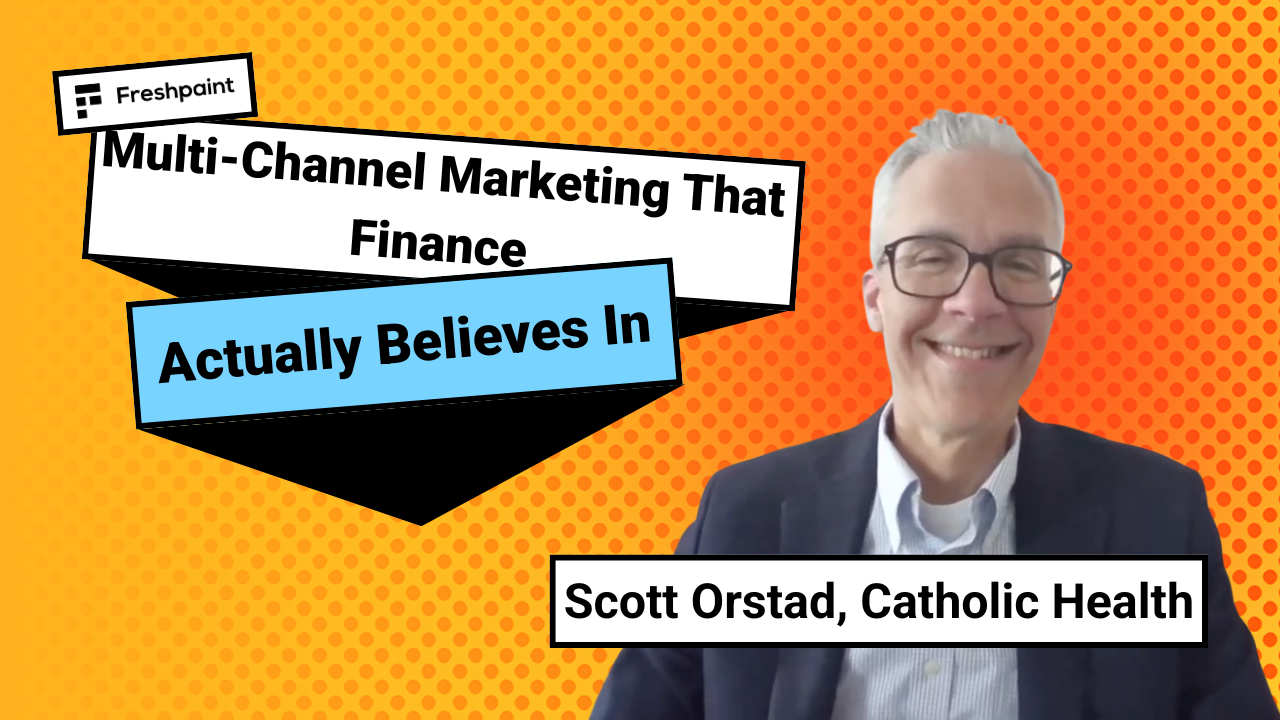
Multi-Channel Marketing That Finance Actually Believes In with Scott Orstad

Brand investment dies in budget meetings. Not because CFOs are wrong to be skeptical—healthcare margins are thin, reimbursement pressure is real, and “trust the brand” has never been a particularly satisfying answer to “show me the ROI.”
It dies because most marketing teams haven't built the measurement infrastructure to make multi-channel spending defensible in the language finance actually speaks.
Scott Orstad has spent two decades figuring out how to change that. As Vice President of Marketing at Catholic Health, he's built a multi-channel strategy in one of the most competitive healthcare markets in the country—one that doesn't just survive budget scrutiny. It earns more of it.
His conversation with Freshpaint CEO and Marketing Rounds host Ray Mina is a practitioner's guide to doing exactly that—without a data science team, without grand theories, and without asking leadership to just trust you.
1. The Paid Search Ceiling Is Lower Than You Think
At some point the keywords are bought, CPCs are rising, and volume has plateaued. There's no obvious next move because you've already captured everyone who knew to look for you.
That's the ceiling—and in healthcare, you hit it faster than most industries because paid search can only reach patients who already know they have a need.
The reason, as Scott explained, is that healthcare demand splits into two fundamentally different modes.
“Search works out great when they're looking for that immediate need. They’re looking up one of your urgent care centers because they need it. Or their primary care doctor told them they needed a referral for a certain type of specialist.” That in-the-moment intent is where search thrives, and the pool of people in that mode at any given time is finite.
Then there’s everything else. Cardiac screenings. Cancer care. Specialist services that people don't know they need yet—or don't know you offer. According to Scott, they better know you exist. “If you come up in the search results with three or four other competitors and no one has ever heard of you, you're likely not gonna get the click anyway.”
This means that you can rank first on every relevant keyword and still lose to the system someone's been seeing ads for all year.
What this means for you
Start by mapping your service lines against two demand types:
- Intent-driven services (urgent care, ER, referral-driven specialties): Search works. Double down, but track attended appointments, not just clicks.
- Awareness-driven services (elective specialties, screenings, new service lines): Search alone won't move the needle. These require brand investment upstream so that the search moment—when it comes—goes in your favor.
If you're seeing rising CPCs, flat volume, and deteriorating efficiency in your search campaigns, you haven't hit a media buying problem. You've hit the intent ceiling. The answer isn't to bid higher—it's to create more demand.
2. Build the Infrastructure Before You Scale the Channel
When Catholic Health relaunched its brand five years ago, they resisted the temptation to immediately pour budget into paid search. They built the website first, then worked with digital technology and the call center to get attribution in place. Only then did they start ramping spend.
“Until some of those infrastructure pieces were working correctly, we didn't ramp up search just for the sake of doing it,” Scott explained. “We wanted to make sure that if we were driving to that conversion—whether it was scheduling online or calling the call center—those points could handle the volume and there was some sense of being able to show the metrics that it was actually working.”
This sequencing matters more than it might seem.
Without attribution and scheduling infrastructure in place before you scale, you're spending performance budget and getting awareness results—impressions, brand lift, maybe some traffic. Which is fine if that's the goal. But if you're trying to prove ROI to finance, awareness results won't get you there.
What this means for you
Run a pre-launch audit before scaling any channel. For each one you're considering, answer:
- Does the landing experience match the promise of the ad? (Mobile-responsive, clear CTA, fast load)
- Can you capture conversions from this traffic? (Online scheduling, call tracking, form fills)
- Do the downstream systems (call center, scheduling) have capacity to handle volume increases?
- Can you attribute outcomes from this channel in a way leadership will believe?
If any answer is no, fix it before spending. Scaling volume into a broken funnel doesn't prove the channel doesn't work—it just produces noise that leadership will use to cut the budget.
3. A Multi-Channel Playbook Finance Can Buy Into
Over the last two years, Catholic Health significantly expanded its outpatient footprint—new centers offering primary care and specialists across multiple markets.
For each launch, Scott's team ran campaigns across paid search, social, email, direct mail, and in some cases local print—staggering the channels intentionally rather than dropping everything at once, so they could see which ones were gaining momentum before the signals blurred together.
The results pushed back against conventional assumptions. “In many cases, the direct mail, email, and social were the largest drivers for the new outpatient centers,” Scott said—not search.
People had driven past the construction site. They'd seen the coming-soon signs. They had geographic awareness but not service awareness. Once the details hit their mailbox or inbox, it became tangible.
What this means for you
For any location launch or new service line promotion, consider building your campaign with this structure:
- Tier your channel launches: Don't drop everything at once. Stagger by 1–2 weeks so you can isolate momentum by channel before noise compounds.
- Instrument everything: Every channel gets a dedicated tracking mechanism: unique phone number, QR code, UTM parameter, trackable URL. No mechanism = no credit.
- Don't write off channels before testing them locally: Direct mail may underperform in a dense urban market and outperform in a suburban one. Geography is a real variable.
- Expand what counts as a conversion: If scheduling infrastructure isn't fully built out yet, track engagement signals (QR scans, soft-schedule clicks, call volume) as leading indicators while appointments catch up.
The Shift Healthcare Marketing Must Make Today
What Scott laid out across this conversation isn't a media theory. It's a sequencing problem. Get the infrastructure right before you scale the channel. Understand which services have a search moment and which ones need to create one. Test channels by market, instrument everything, and accept that the mix will look different every time.
None of it requires a data science team. It requires discipline about what you're measuring, honesty with finance about what you're taking credit for, and the patience to let results accumulate before claiming victory.
"Both brand and performance marketing need to both exist for an organization to be successful," Scott said. "It's just finding the right mix and the happy intersection of the two."
Experience the full conversation where Scott discusses how Catholic Health built its content and email marketing strategy from the ground up, why tiering your channel launches reveals insights no analytics dashboard can, how to have the "revenue generating department" conversation with skeptical leadership, and the crawl-walk-run attribution approach that turned financial leadership into marketing advocates.






.png)