Why Multi-Location Dermatology Groups Can't Afford Inconsistent Tracking — And How to Fix It
.png)

Multi-location dermatology practices are growing fast — through acquisitions, regional expansion, and the addition of service lines like med spas and plastic surgery. But as organizations add locations and brands, they inherit a different kind of problem: every acquired practice tracks patient demand in its own way.
One location counts a "lead" as a form fill on a cosmetic consult page. Another counts it as a booked Mohs surgery appointment. A third is still running agency-managed pixels on their CoolSculpting and laser resurfacing pages that no one on your team fully controls.
The core issue for most growing dermatology groups is not a lack of data. It's that the data you have can't tell a consistent story across your portfolio — whether that portfolio spans general dermatology, Mohs surgery, cosmetic services, med spa, or plastic surgery. The fix is to ensure every location, service line, and brand in your portfolio is tracking the same events, using the same definitions, and feeding data into the same trusted foundation.
This blog post breaks down what that looks like in practice, and why the groups that get there first will have a competitive advantage. You’ll learn:
- Why inconsistent tracking becomes a real growth problem as you scale
- What it actually looks like when measurement is standardized across derm locations
- How centralized oversight and local flexibility can work together
- The business outcomes that follow when your data foundation is solid
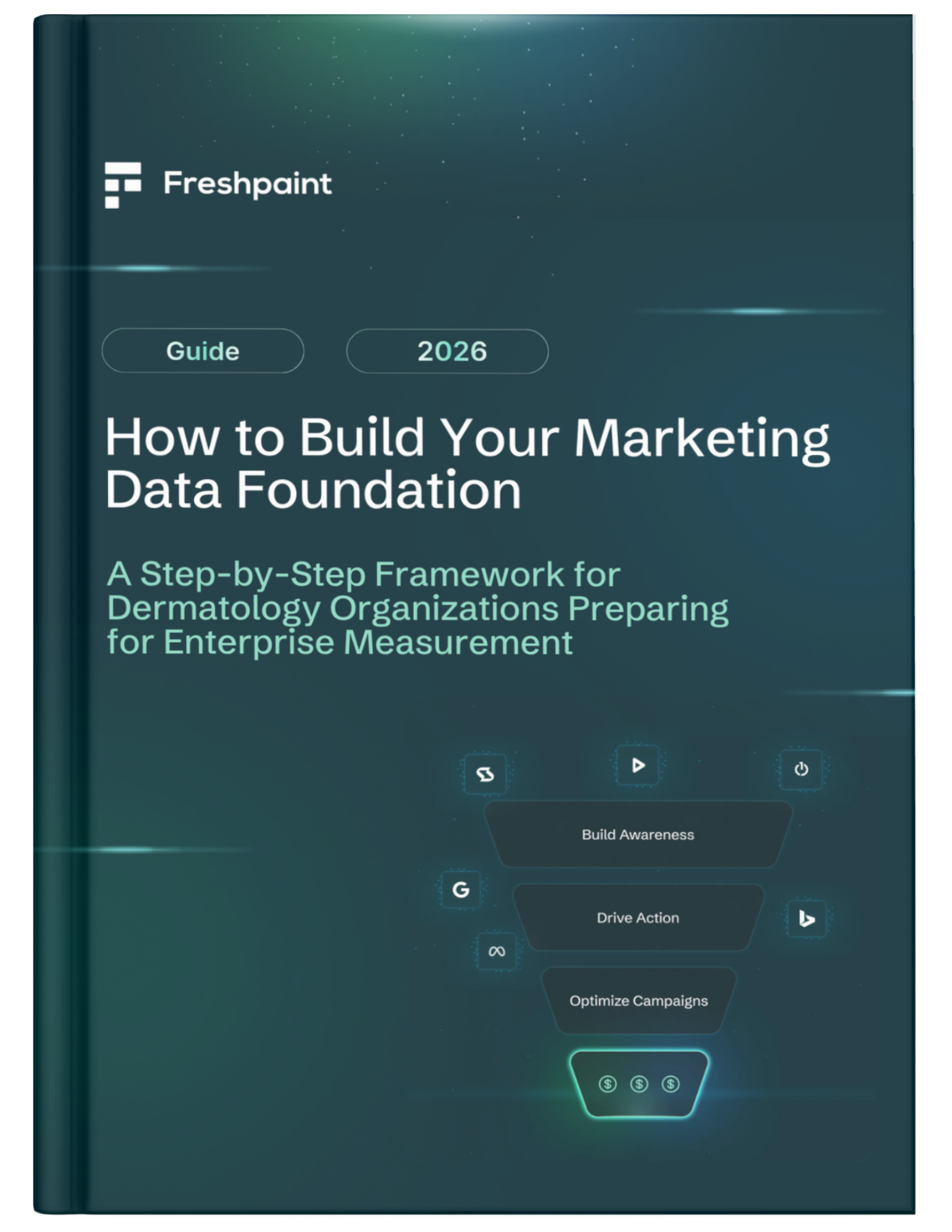
Go deeper into enterprise measurement by downloading our guide on how to build your marketing data foundation for dermatology organizations.
Key Takeaways for Dermatology Marketing Leaders
- HIPAA-compliant tracking is the starting point, not the finish line. The real opportunity is what becomes possible once every location — from your flagship Mohs center to your newest med spa acquisition — is measuring the same things the same way.
- You can have enterprise-wide visibility without micromanaging local teams. The right foundation lets corporate marketing see what's happening across every brand while local teams keep the flexibility to act on their own markets.
- Better data directly drives better growth decisions. When you can reliably connect campaigns to booked and attended appointments — whether for a cosmetic consult, a skin cancer screening, or an injectable treatment — you can invest more confidently and prove marketing's impact on revenue.
The Problem: Your Portfolio Looks Unified, But Your Data Doesn't
As Healio recently noted, dermatology is entering a "consolidation of consolidators" phase, and every acquisition adds another layer of measurement complexity on top of the last.
Here's a scenario most multi-location derm marketing leaders recognize. You've acquired practices over the past few years: some pure medical dermatology, some with cosmetic divisions, some with attached med spas. On paper, it looks like one organization. Underneath, it behaves like several:
- Your Mohs program fills schedules through physician referrals.
- Your cosmetic division runs paid social for laser treatments and injectables.
- Your med spa promotes membership packages through its own brand and booking flow.
Each service line attracts a different patient — and gets tracked, if at all, by a different team using different tools.
That fragmentation compounds with every acquisition. New websites, booking systems, and agencies optimizing for different metrics. One location on GA4, another still on Universal Analytics, and a third still running a Meta pixel on booking confirmation pages.
The lack of a shared measurement foundation usually surfaces when leadership asks a question that should be simple enough to answer: Are our cosmetic campaigns at the Buckhead location outperforming the ones in Alpharetta, or does it just look that way because one counts form fills and the other counts booked appointments?
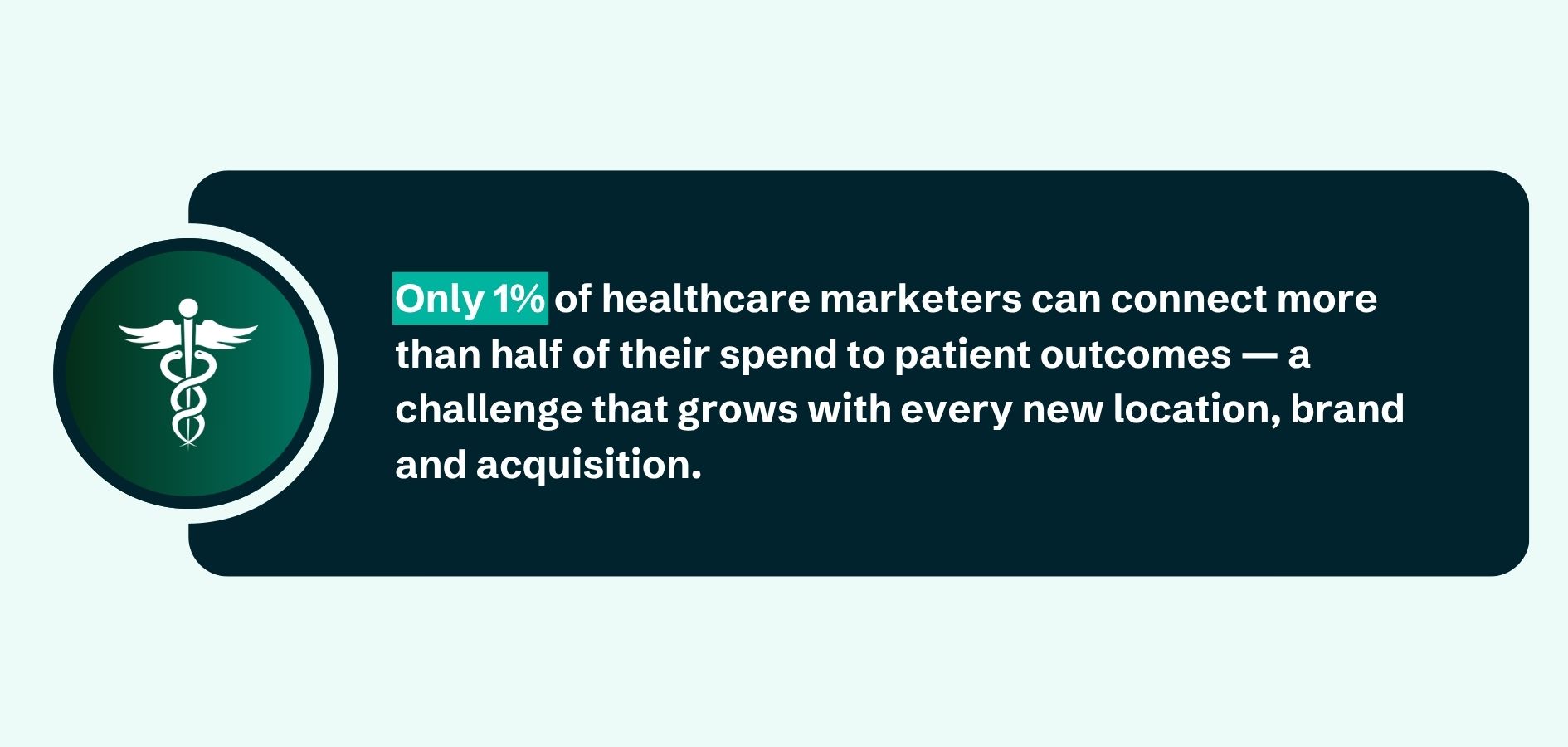
Only 1% of healthcare marketers can connect more than half of their spend to real patient outcomes, according to our recent industry research. In a multi-location derm group, that gap gets wider every time a deal is closed.
What Breaks When Every Location Measures Differently
When tracking isn't standardized across your locations and brands, a few things tend to contribute to inconsistent reporting and increased risk:
- Cross-location comparisons become unreliable. You can't tell whether your Alpharetta cosmetic division is actually outperforming your Atlanta location, or whether Alpharetta’s numbers look better because they're counting cosmetic consult requests while Denver is counting attended appointments.
- Service line performance is not read clearly. If your Mohs program, cosmetic division, and med spa are all tracking conversions differently, there's no way to know which service line is delivering the best return on ad spend and which needs more support.
- Teams spend their time reconciling dashboards instead of optimizing campaigns. When a field marketing manager in one region uses different definitions than the agency managing your cosmetic paid search, someone has to manually audit and reconcile before any decision can be made. Over time, this compounds into hours and resources that don't go toward growth.
- Privacy reviews become reactive. One acquired practice still has a tracking pixel firing on their psoriasis treatment landing page. Another has a retargeting tag running on a page where patients enter insurance information. You don't know until something surfaces, and in healthcare, finding out reactively is already too late.
- Optimization goes toward activity, not outcomes. You're measuring clicks on a CoolSculpting ad and form fills on a cosmetic consult page, but you have no visibility into whether those patients showed up, completed treatment, or converted into long-term dermatology patients. As a result, marketing lacks the ability to tell a full-funnel patient acquisition story.
What It Looks Like When Tracking Is Standardized
Once your locations are measuring the same things in the same way, four positive shifts tend to happen consistently.
1. You can actually compare performance across locations
When data is collected and defined consistently across every property, you can compare markets with confidence. You have the data to understand if your Mohs program in one market generates more attended appointments per ad dollar than another, and whether cosmetic consult requests convert to booked appointments at a higher rate in locations that use a specific landing page format.
Outcome: Marketing and growth teams can identify which locations are outperforming, replicate what's working, and address underperformance with precision, rather than second-guessing whether the numbers are comparable.
2. You stop optimizing for clicks and start optimizing for patients
Standardized tracking lets you follow patient demand all the way through the funnel — from a cosmetic consult request or a Mohs booking to an attended visit and downstream patient value. Freshpaint customers at multi-location practices use this to move beyond surface-level engagement metrics and understand the tactics that drive patient acquisition across service lines. A paid social campaign for laser skin resurfacing looks very different when you're measuring attended appointments versus form fills.
Outcome: Marketing spend gets optimized toward outcomes, not platform-reported conversions.
3. Marketing and operations get aligned
With visibility into downstream performance, marketing teams can see where patient demand is outpacing capacity, or where certain providers and locations have room to grow. If your cosmetic campaigns are generating strong consult requests in a market where your aesthetic provider has a three-week wait, that's a signal. If your Mohs program has open slots but low referral volume in a specific region, that's a different kind of signal. Both only become visible when your marketing data connects to operational reality.
Outcome: Budget decisions can be made in coordination with operations, as opposed to guesswork.
4. Corporate visibility and local flexibility coexist
A shared measurement foundation doesn't mean every local team loses autonomy. It means corporate marketing gets the visibility and governance it needs — consistent privacy standards, standardized definitions, reliable cross-brand reporting — while local teams keep the flexibility to run their markets. The med spa in one region can still run its own seasonal promotions and the cosmetic division in another market can still work with its own agency. What changes is that everyone is measuring success the same way, so the results are actually comparable.
Outcome: Enterprise teams gain centralized control over how measurement is implemented across brands, without requiring every local team or agency to manage tracking independently.
Getting toward standardized tracking does not start with dashboard or another agency audit. It's a simple, shared tracking foundation — a single layer that governs how patient interactions are defined, collected, and measured across every website, booking flow, and brand in your portfolio. When that foundation exists, the questions leadership has been asking about location performance, leads, and marketing compliance risk are easily answered.
How Large Dermatology Platforms Think About Measurement at Scale
The organizations that get this right aren't necessarily the ones with the most sophisticated tech stacks. They're the ones that solved a simpler problem first: getting every location to agree on what they're measuring and how.
That means:
Consistent privacy standards across every property. Every website, form, and booking flow — whether it's a general derm intake form, a cosmetic consult request page, or a med spa membership sign-up — needs to collect data the same way, filtered and governed to meet HIPAA requirements while still preserving what you need for attribution.
Shared definitions for what matters most. What counts as a booked Mohs appointment versus a cosmetic consult request versus a med spa inquiry? What qualifies as an attended visit for a laser treatment versus a skin cancer screening? When every brand and agency defines these differently, cross-location reporting is unreliable. Standardizing these definitions and implementing them consistently across every property makes meaningful comparison possible.
A central view across all your brands. Corporate marketing teams need visibility into how measurement is performing across every property: where tracking is working, where there are gaps, how cosmetic performance in one market compares to another in real time. Freshpaint gives enterprise teams centralized visibility and governance over measurement implementation across websites, booking flows, and downstream platforms.
Attribution that connects campaigns to revenue. The goal is knowing which campaigns perform. Imagine being able to quickly ascertain the strategies that drove attended Mohs consultations, answer what patient acquisition looks like across cosmetic versus medical dermatology, and easily report how your med spa marketing spend maps to downstream revenue. By standardizing how data flows into analytics and ad platforms, Freshpaint makes this level of attribution possible in a privacy-safe environment.
Bottom Line: Better Measurement Means Better Growth Decisions
For large dermatology groups, HIPAA-safe tracking is table stakes. The real opportunity is building the measurement foundation that lets you:
- Compare performance reliably across brands and locations — general derm, cosmetic, med spa, and plastic surgery
- Connect marketing spend to patient outcomes, not just clicks on a CoolSculpting ad or a form fill on a Mohs referral page
- Improve attribution across every service line, so you know what's actually filling schedules
- Make confident, data-driven decisions about where to invest next — whether that's a new cosmetic campaign, a Mohs expansion, or a med spa acquisition
The organizations that win in this consolidating market will be the ones with the clearest picture of what's driving patient demand across their network, and the data foundation to act on it.
Freshpaint is trusted by 250+ healthcare organizations as their privacy-safe measurement foundation — standardizing data collection, improving governance, and enabling better growth decisions without adding compliance risk.
Ready to see which campaigns are actually driving booked and attended appointments?
- Freshpaint helps dermatology groups measure what's working, protect patient data, and scale patient acquisition without adding compliance risk. See how.
- Go deeper into enterprise measurement by downloading our guide on how to build your marketing data foundation for dermatology organizations.
- Not sure where your tracking stands today? Scan your website for privacy risks for free.







.png)